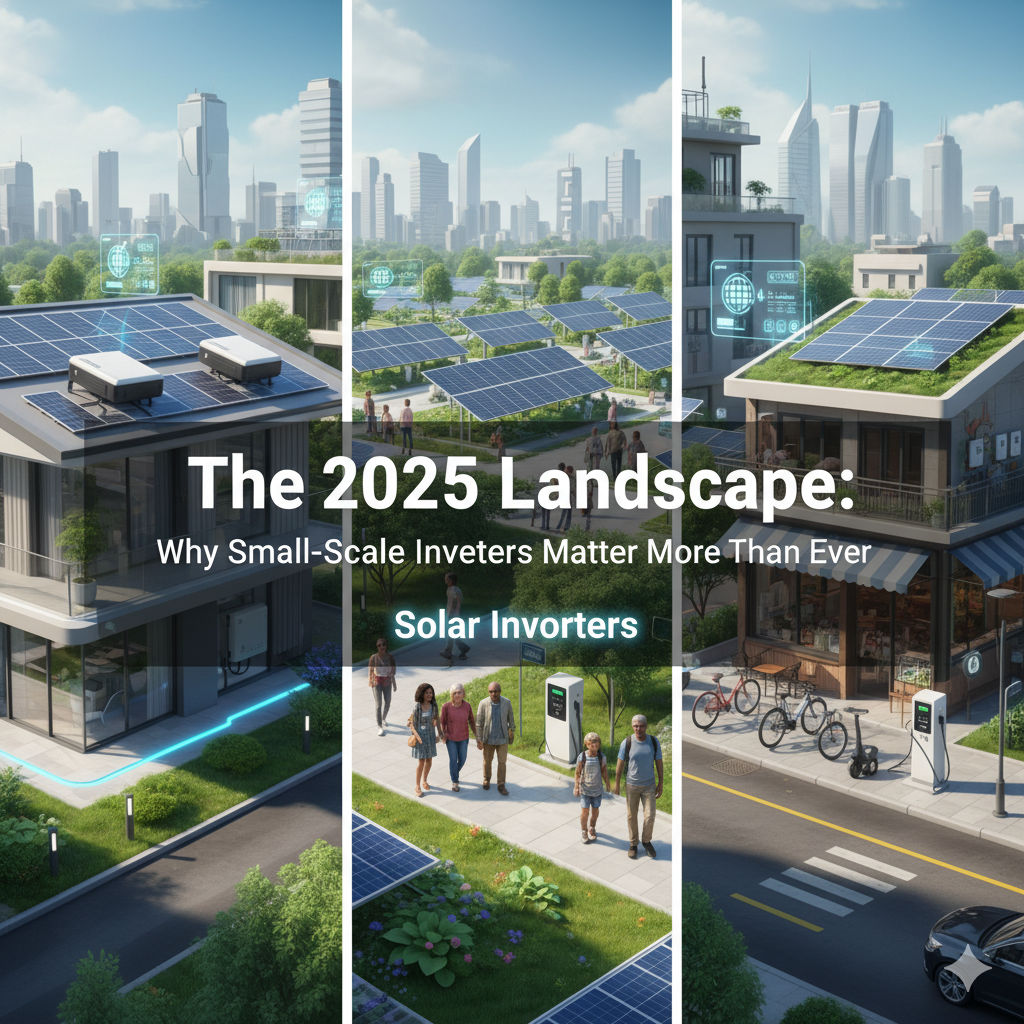
The 2025 Landscape: Why Small-Scale Inverters Matter More Than Ever
Solar power systems are evolving—but not just getting bigger. In 2025 the shift is toward smarter, distributed, and hybrid-capable systems. For homeowners and commercial facility managers alike, the inverter has become a decision point.
Recent market data shows the residential solar PV inverter market is worth over USD 4.2 billion in 2024, and is projected to grow at a CAGR of around 5.8% through 2034. Global Market Insights Inc.+1
Meanwhile, global industry commentary points to a rebound in inverter shipments—expected to increase by around 7–8% globally in 2025. pv magazine International
This implies: smaller scale systems, when optimized, can deliver big impact—whether in energy savings, grid support, or user experience.
Core Trends Shaping Inverter Use in Homes and Businesses
Here are the key shifts that practitioners and buyers must understand.
Trend 1: Hybrid Integration Becomes Standard
Residential and commercial systems increasingly combine solar + battery + grid. Inverters with hybrid modes, bidirectional flow, and storage-ready design are no longer premium options—they’re baseline. This allows overnight backup, peak-shifting, and improved self-consumption.
Trend 2: Smart & Connected Features Amplify Value
“Smart inverter” is more than a label. In 2025, inverters feature remote monitoring, AI-based fault detection, and integration with home/office energy management systems. SRNE Solar For businesses, this means less maintenance downtime; for homeowners, better visibility and control.
Trend 3: Commercial Scale Looks Smaller—and Modular
Commercial installations used to mean megawatt-scale. Now, many facilities (retail units, small offices, restaurants) employ 20–100 kW systems. Inverters suited for “smaller” commercial use bridge the gap between residential and utility — delivering high performance in a compact size.
Trend 4: Grid Compliance & Export-Ready Features Gain Importance
With net-metering rules evolving and grid operators expecting more from DERs (distributed energy resources), inverters now must deliver reactive power control, export monitoring, and safe anti-islanding. huawei
Trend 5: Market Maturity Drives Cost Optimisation
As competition increases, inverter manufacturers are improving efficiency and reducing Balance-of-System (BOS) costs. Fewer components, simpler wiring, and smarter control logic contribute to smaller system cost per kW. This makes small scale systems more accessible and more impactful.
From Rooftops to Retail, Real Impact in Action
Rather than abstract trends, let’s look at real-life environments where these inverters deliver value.
Residential: Suburban Home with EV Charging
Imagine a 6 kW rooftop system paired with a battery and EV charger. A smart inverter monitors load, shifts solar power to evening EV charging, and exports only when grid conditions are favourable. The homeowner enjoys lower bills, better resilience, and a smoother ROI.
Small Commercial: Café + Office Space
A business installs a 30 kW solar array on its roof. The inverter supports hybrid operation: uses stored solar during evening business hours, exports midday, and maintains backup for power interruptions. Maintenance is simplified thanks to remote monitoring and modular design.
Multi-Tenant Commercial: Retail Park
A retail park deploys multiple string inverters (each 50 kW) across buildings. These are networked via the EMS (Energy Management System). When one unit has a fault, the rest continue normal operation—minimizing disruption and optimizing O&M cost.
Non-Profit / Community Centre
A community centre in a region with high electricity tariffs installs a 15 kW inverter system with battery integration. During tariff peaks the system uses stored energy, while exporting during mid-day. This turns investment into long-term value and community benefit.
How to Choose the Right Inverter for Small & Mid-Scale Projects
Here’s a practical checklist one must walk through—each point matters for performance and user satisfaction.
| Factor | What to Test | Why It Matters |
|---|---|---|
| Capacity Fit | Match inverter to expected solar array size plus 10–20 % margin | Prevents over-sizing or unnecessary cost |
| Hybrid Capability | Supports battery interface, “self-consumption” modes, export control | Future-proofs the system |
| Monitoring & Connectivity | Remote dashboard, alerts, firmware updates | Lowers maintenance burden |
| Efficiency Curve | High efficiency especially at partial load (e.g., 30–70%) | Many systems operate in this band |
| Grid Interface Compliance | Meets local grid codes, reactive power control, export measurement | Ensures approval and revenue eligibility |
| Physical & Installation Fit | Weight, mounting, noise, ambient temperature rating | Affects installation cost & longevity |
| Service & Warranty | 10-15 year warranty, global support network, spare parts availability | Protects investment and reliability |
Tip: For residential + small commercial systems, focus on modular string inverters or hybrid single-phase models rather than large central units. They deliver flexibility and lower risk.
FAQs — Direct Answers to Key Buyer Questions
Q1: Do hybrid inverters add significant cost in small systems?
Not necessarily. While the upfront cost is slightly higher, hybrid models reduce future spend on separate battery controllers and allow better load management—leading to better ROI over time.
Q2: Are smart features justified in small commercial installations?
Yes. Even for systems <50 kW, remote diagnostics, alerting, and dashboard monitoring reduce downtime and maintenance cost—especially valuable in high-tariff or high-reliability environments.
Q3: How long will inverter technology stay relevant?
Good models offer firmware updates and modular design. If you choose a strong brand with global service, the system can operate reliably for a decade or more—then most parts refresh will further extend life.
Q4: Is export control still important for small installations?
Yes. Many utilities now require export measurement or limit export volumes. Having inverters with “self-consumption first” logic helps optimise onsite use and avoid export penalties.
Big Impact From Small Systems
Inverter selection in 2025 is less about maximum capacity and more about smart integration, operational resilience, and business logic. For residential users and small commercial operators, the right solar inverter can deliver cost savings, reliability, grid-friendliness, and future readiness.
At ThlinkSolar, our inverter solutions span residential to commercial projects—offering hybrid functionality, smart monitoring, and global compliance. Ready to evaluate your next system? Visit our homepage or reach out via the contact page for tailored support.