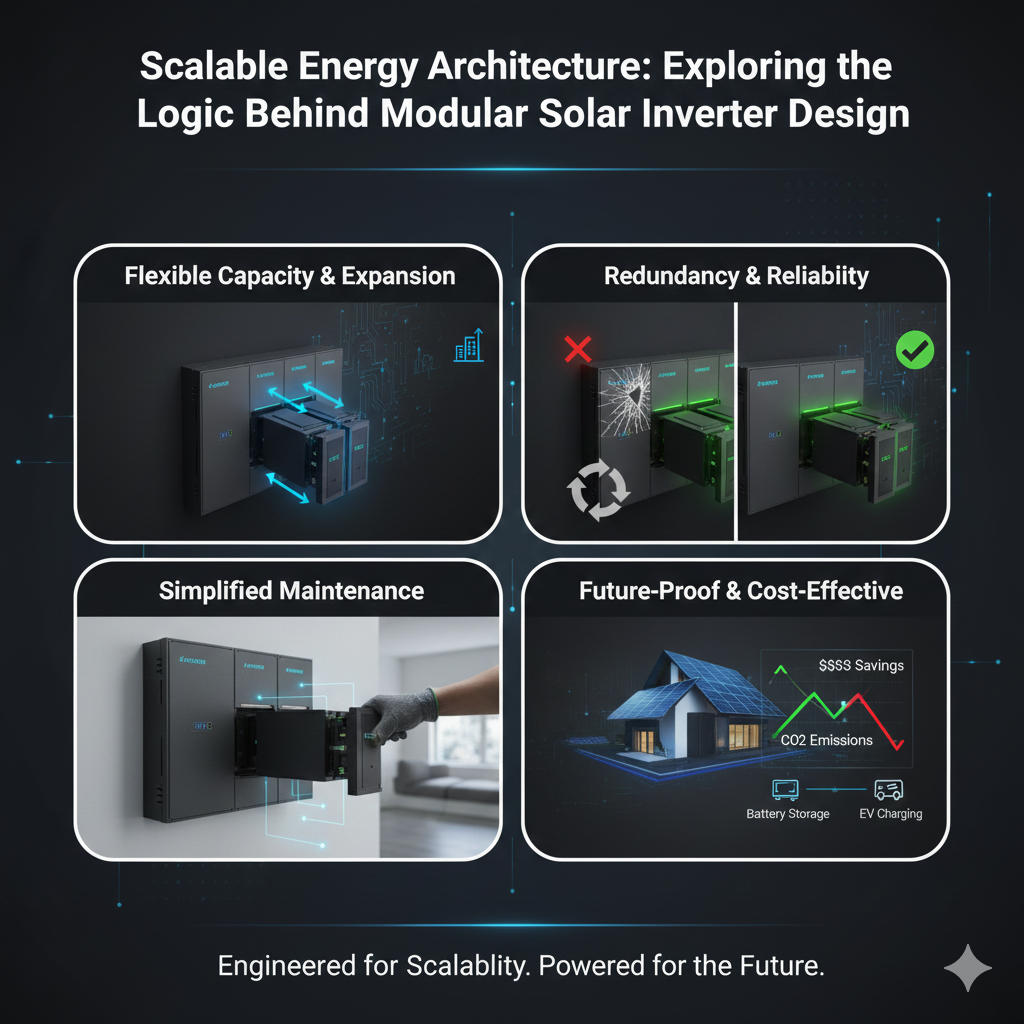
Scalable Energy Architecture: Exploring the Logic Behind Modular Solar Inverter Design
The future of solar power lies not only in how efficiently energy is generated, but also in how flexibly it can be managed and expanded. As projects grow in size and complexity, system adaptability becomes as critical as energy output.
A modular solar inverter design addresses this challenge by allowing solar systems to operate as interconnected power units rather than a single monolithic block. When one module is upgraded, replaced, or serviced, the rest of the system continues operating—preserving uptime, simplifying maintenance, and ensuring long-term scalability.
Why Modular Architecture Matters for Solar Systems
Conventional inverter systems are typically centralized. While this approach simplifies installation, it also creates a single point of failure. If a fault occurs, the entire array may go offline. Modular designs solve this problem through distributed power conversion, where each inverter module works independently but cooperates with the network as a whole.
This distributed logic brings three core advantages:
-
Fault Isolation: When one module fails, the others keep functioning, minimizing energy loss.
-
Easy Scalability: Adding capacity doesn’t require reconfiguring the entire system—just connecting additional inverter modules.
-
Simplified Maintenance: Replacement or repair can occur without full system downtime.
By decoupling power control into manageable units, modular design aligns with the growing demand for reliability in large-scale solar farms and industrial projects.
Inside the Engineering: How Modular Inverter Design Works
A modular solar inverter consists of several independent conversion modules, each containing a DC/DC and DC/AC conversion stage. Thlinksolar employs a parallel control architecture supported by intelligent synchronization algorithms that coordinate module communication and power output.
Each module features:
-
Real-Time Load Balancing: Automatically distributes power among modules to prevent overloading.
-
Hot-Swap Functionality: Modules can be replaced or added without shutting down the system.
-
Redundant Control Channels: Ensures continuous operation if a control board or communication link fails.
-
Uniform Firmware Logic: Maintains system stability regardless of module quantity or configuration.
This combination of hardware independence and software unification creates an inverter platform that’s both robust and easy to manage—ideal for growing renewable installations.
Technical Features and Structural Advantages
| Design Element | Technical Description | System Benefit |
|---|---|---|
| Modular Power Units | Independent inverter blocks with integrated controllers | Enables flexible expansion and faster fault isolation |
| Parallel Synchronization | Active current-sharing and frequency matching across modules | Prevents imbalance and improves conversion efficiency |
| Plug-and-Play Configuration | Tool-free connection interface between modules | Reduces commissioning time and complexity |
| Thermal Redundancy Design | Smart cooling distribution across modules | Extends system lifespan and improves reliability |
| Centralized Data Link | Unified communication gateway for system-level control | Simplifies remote monitoring and firmware updates |
Each design element works toward one goal: maintaining consistent power delivery in variable, large-scale solar environments.
Industrial and Commercial Applications
The benefits of modular solar inverter design extend across a wide range of sectors:
-
Utility-Scale Solar Plants: Simplify scaling and maintenance in multi-megawatt projects.
-
Commercial Rooftop Systems: Optimize load distribution while supporting flexible capacity growth.
-
Industrial Energy Parks: Enhance operational stability with redundant inverter configuration.
-
Remote and Hybrid Microgrids: Maintain reliable off-grid power even if one module fails.
By combining flexibility with reliability, modular systems enable operators to adjust capacity in real time, matching energy demand growth without expensive overhauls.
Key Advantages for System Owners and Integrators
-
Higher Uptime: Localized module control ensures faults don’t shut down the full array.
-
Faster Deployment: Pre-configured modular components shorten installation and setup.
-
Ease of Service: Maintenance can occur on a per-module basis without halting operations.
-
Lower Lifecycle Costs: Reduced downtime, simpler logistics, and scalable structure improve long-term ROI.
-
Future-Proof Design: New modules can integrate with existing systems through standardized communication and power interfaces.
This adaptability transforms solar infrastructure from a static investment into an evolving, upgradable system capable of meeting future energy requirements.
Integration and System Compatibility
To accommodate diverse deployment models, Thlinksolar’s modular inverter platform supports RS485, Modbus, and CAN bus communication, enabling real-time system synchronization. The units are fully compatible with hybrid energy storage systems, battery banks, and smart grid infrastructures.
All inverters are tested for CE, TUV, and VDE standards and undergo multi-environment stress validation to ensure consistent performance under heat, humidity, and high-load conditions.
For EPC contractors and OEM clients, customizable module configurations and flexible control logic make integration straightforward, efficient, and globally deployable.
Frequently Asked Questions
Q1: How does modular inverter design improve reliability compared to traditional centralized systems?
A: Each module operates independently, so if one fails, others continue supplying power. This structure drastically reduces downtime and operational risk.
Q2: Is modular design suitable for smaller commercial systems?
A: Yes. Even small-scale systems benefit from modular inverters due to simplified maintenance, remote monitoring, and scalable future expansion.
Building the Foundation for Scalable Solar Infrastructure
Scalability defines the future of renewable energy. A modular solar inverter design ensures that system growth, maintenance, and modernization remain simple, predictable, and cost-effective.
Through years of technical refinement, Thlinksolar continues to develop inverter platforms that combine modularity, safety, and intelligence—helping energy providers and industrial users maintain efficient, adaptable, and reliable solar systems for decades ahead.
For detailed specifications or integration consultation, visit Thlinksolar.com or contact our engineering team.