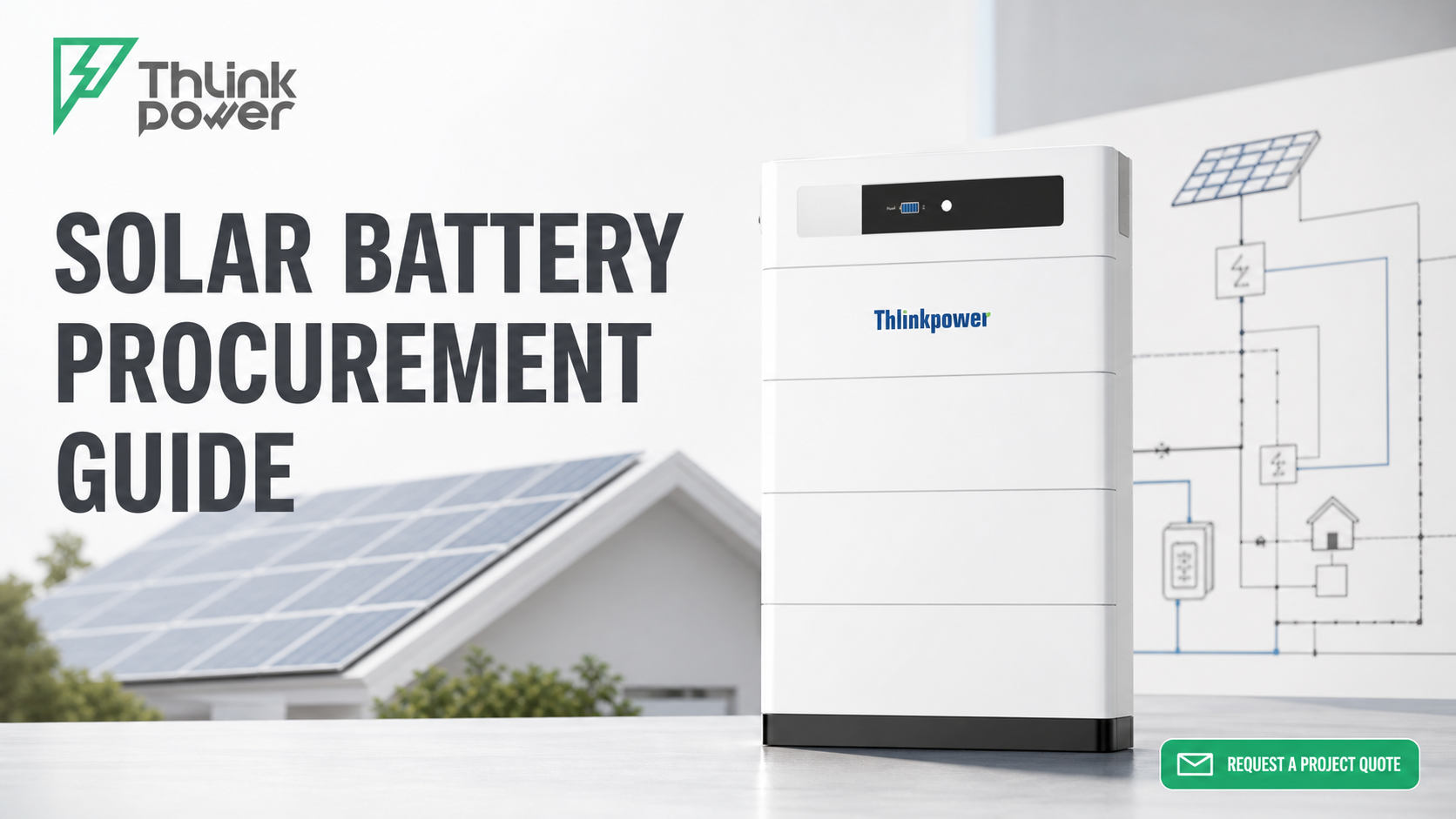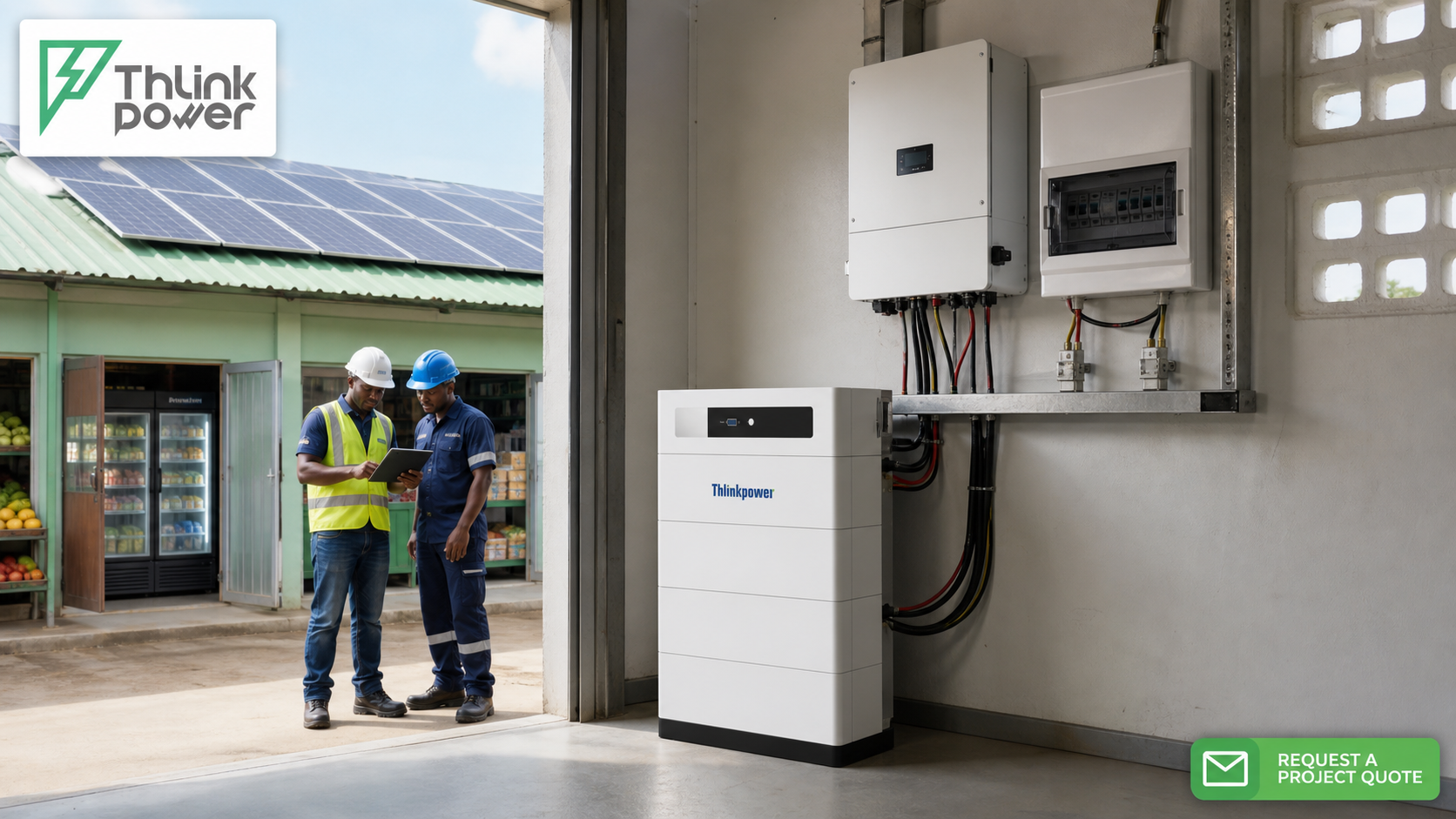
Short answer: a big kWh label and a big cycle number are the beginning of the conversation, not the purchase decision. My first question is usually ordinary: “What has to stay on, and for how long?” From there we check usable energy, the worst power step, room temperature, the exact inverter pair, safety papers and the claim route. A cheap kWh stops looking cheap when any one of those was left out.
This is a working buyer’s guide for distributors, EPC teams, storage integrators and commercial owners comparing LiFePO4 products. The emphasis is practical: turn an incomplete message into an RFQ, read DoD and cycle claims without wishful thinking, normalize two quotations, and test a sample before the container. Where THLinkSolar has a published value, it is named. Where the exact model paper is still needed, that is said plainly too.
A battery does not deliver its catalog kWh in isolation. The BMS makes decisions; the inverter asks for current; cables and protection add limits; the room gets hot. Daily depth, cycle count and long periods near full charge leave different fingerprints on aging. Write that operating story down first. Otherwise the tender compares promises made for different jobs.
Send Your Load Profile and Backup Hours for a Battery Sizing Review
1. Why battery quotations that look comparable often are not
Imagine three offers described as “10 kWh LiFePO4.” The first uses 10 kWh as nominal energy and recommends 80% depth of discharge, leaving 8 kWh before other operating limits.The second lists 10 kWh usable but does not state the end-of-discharge voltage or test temperature. The third combines two 5.12 kWh modules and quotes a cycle number from a cell datasheet rather than a pack-level test. The headline is similar; the evidence is not.
Power may also differ. A battery can contain enough energy for several hours yet be unable to start a compressor or support the inverter’s full backup output. Communication may be absent. The enclosure may be intended for a clean indoor room while the buyer plans to install it outdoors. One quotation may include parallel cables, breaker, base and communication harness; another may include only battery modules.
A responsible solar battery supplier should identify those differences explicitly. A responsible buyer should reward that clarity rather than compare only the first price line.
2. Begin with the duty cycle, not the battery catalog
The duty cycle is the battery’s job description. A backup battery that waits for occasional outages has a different life pattern from a battery that shifts solar energy every day. A telecom site may cycle shallowly but remain in high heat. A cold-room system may experience large evening loads and frequent compressor starts. A commercial tariff project may discharge during a narrow peak window and recharge from grid or PV.
Questions that define the job
- What loads must the battery support, and which are critical?
- How many kWh are needed per event, day or night?
- What is the maximum continuous power and largest starting demand?
- How many cycles are expected per day or per year?
- What normal state-of-charge window will the controller use?
- Will the battery provide backup, self-consumption, peak shaving, generator support or several services?
- What temperature will the cells experience, not merely the outdoor weather?
- How long must backup last after a low-sun period?
- How often can the operator inspect or service the installation?
If the meter can export fifteen-minute or hourly data, send the file—one month of detail often answers questions that twelve monthly bills cannot. On a new building, use a rough equipment sheet instead: quantity, running watts, how each motor starts, operating hours, which loads overlap and which ones matter most. Put “assumed” beside guessed values. That little word prevents a budget estimate from becoming accidental fact.
3. Nominal energy, usable energy and delivered AC energy
The catalog arithmetic is simple: nominal volts multiplied by ampere-hours. A 51.2 V, 100 Ah module therefore carries a 5.12 kWh nominal label. Keep the word nominal on the same line. The cold-room compressor at the AC panel will not receive that entire number.
Usable DC energy depends on the permitted state-of-charge window and BMS limits.Delivered AC energy is lower again because the inverter, cables and auxiliary systems consume or lose energy. At low temperature, high power or an aged state, available energy can differ from the catalog condition.
A transparent estimate separates the stages:
Nominal DC energy × allowed depth of discharge × battery-side availability × inverter efficiency = estimated usable AC energy.
Each factor should be tied to a test, datasheet or declared design assumption. Avoid using a single optimistic efficiency value for every power level and direction. In a hybrid system, charging and discharging pass through different conversion paths.
A hypothetical sizing example
Try the math on a fictional shop that needs 16 kWh after the grid fails. For an early estimate, let the normal window use 80% of nominal capacity and let 92% reach the AC side. The first-pass result is 16 ÷ 0.80 ÷ 0.92, roughly 21.7 kWh nominal. I would not order from that line alone. We still need reserve, aging, room temperature, starting power and any expected load growth. The example teaches the calculation; it is not a project quote.
The example shows why an installer should not promise “two 10 kWh batteries give 20 kWh backup.” The units, limits and losses must be stated.
4. Depth of discharge: define the start and end points
Depth of discharge, or DoD, describes how much of a battery’s capacity has been removed relative to a defined full condition. A cycle from 100% state of charge to 20% state of charge is commonly described as 80% DoD.Yet the measurement method, voltage limits, current, temperature and balancing behavior still matter.
THLinkSolar’s current stacked-battery product information recommends 80% DoD for a 51.2 V modular family. That is a useful design input for the named product page. It should not be turned into a universal rule for every battery chemistry or model.
Deeper cycling generally uses more energy per cycle but can increase degradation stress. Shallow cycling uses less energy in each event but may require more installed capacity for the same service. The economic decision depends on battery cost, replacement expectations, duty-cycle revenue, backup reserve and warranty conditions.
Ask a supplier to state:
- Recommended operating state-of-charge window.
- Absolute BMS protection limits and whether the operator can change them.
- Test DoD used for the published cycle claim.
- Charge/discharge rate, temperature and end-of-life capacity used in that test.
- Whether the claim is for cells, modules or a complete battery system.
5. Cycle life is a test result with conditions, not a calendar promise
A cycle-life number is meaningful only when its conditions are visible. Buyers should request the test profile, not just a large integer on a brochure. Important variables include cell chemistry and format, DoD, charge and discharge rate, temperature, rest periods, state-of-charge range, end-of-life threshold and balancing strategy.
A “cycle” also needs definition. One complete discharge and recharge may be one cycle, while partial events may be counted as equivalent full cycles.A project that cycles 20% five times is not necessarily identical to one 100% event because the state-of-charge path and time at each state differ.
Published research models reinforce the need for conditions. An NREL study of storage degradation modeled depth of discharge, temperature, cycle counting and calendar aging rather than treating cycle life as a fixed counter. See the official NREL comparative study of storage dispatch and degradation. The study is not a test of THLinkSolar products; it is cited to explain why procurement must capture operating assumptions.
How to read THLinkSolar’s published cycle statements
There is a reason to pause at THLinkSolar’s current product page. One FAQ line says “6000 cycle life and 80% DOD.” Farther down, the page mentions 6000–8000 cycles and a 5–10 year cell warranty. Those sentences are not a model-specific warranty schedule. Do not select the largest number for a customer brochure. Ask sales for the exact model sheet, its cycle-test conditions and the warranty that will be attached to this order.
This distinction protects both parties. The supplier avoids an unsupported promise, and the buyer receives a document that can be compared with the planned duty cycle.
6. Calendar aging can matter even when cycling is light
Batteries age with time as well as use. Temperature and time spent at high state of charge can influence calendar aging. A backup system that rarely discharges may still lose capacity over years, particularly in a hot equipment room.The correct operating strategy therefore depends on the service.
For a standby application, ask whether the battery should remain at full charge, maintain a reserve window or perform periodic maintenance cycles. For daily self-consumption, confirm the upper and lower state-of-charge limits. For seasonal projects, define storage procedure during long idle periods.
THLinkSolar’s product page advises storing the referenced battery in a dry, clean and ventilated warehouse at 10–35°C and maintaining it periodically when unused. A project-specific manual should govern the actual model. The importer should also define who monitors storage state of charge after arrival, especially if customs or site work delays commissioning.
7. Charge and discharge power: the kW behind the kWh
Energy capacity answers “how long.” Power answers “how much at once.” Both must meet the load. The battery’s continuous current, peak current and allowed duration must be coordinated with inverter demand, cable, breaker, connector and thermal limits.
For a 51.2 V nominal battery, 100 A corresponds to approximately 5.12 kW before losses and voltage variation. Two parallel modules may increase available current if the manufacturer permits the configuration and the busbar, cables and protection are designed for it. Do not multiply values mechanically without the system rules.
THLinkSolar’s published 5.12–25.6 kWh stackable family lists standard discharge current increasing from 100 A for one module to 500 A for five modules, and standard charge current from 50 A to 250 A. These are product-page values.The buyer should confirm the exact module count, BMS architecture, cable set, breaker and inverter setting for the proposed order.
Motor and compressor loads
A battery can have sufficient energy yet trip during a motor start. Review the inverter overload capability and battery peak-current limit together. Record the motor’s starting method and sequence loads where possible. For a refrigerated shop, for example, the freezer compressor, cold-room compressor and water pump should not all restart simultaneously after an outage unless the system is designed for that event.
8. Low-voltage versus high-voltage battery architecture
Low-voltage systems commonly use a nominal 48 V class battery. They are familiar to many installers and appear in residential and smaller commercial systems. Current becomes substantial at higher power, so cable length, conductor size, termination quality and protection require attention.
High-voltage battery systems can reduce current for a given power and are used with compatible hybrid inverters. They introduce different insulation, isolation, connector, service and safety requirements. A high-voltage stack is not simply a group of 48 V batteries connected in series unless the manufacturer has designed and approved that architecture.
THLinkSolar’s published stackable family is nominally 51.2 V with a 43.2–57.6 V working range. THLinkSolar’s TP-REVO HES and TP-SPI inverter platforms are examples of low-voltage battery interfaces. The TP-ESS/TP-EPH three-phase hybrid family is documented with a 130–700 V battery range.The sales engineer must pair the selected battery and inverter explicitly.
For a buyer comparing a complete commercial solar system, architecture should be selected before requesting the final battery price. Changing from low voltage to high voltage can change the inverter, battery modules, controller, cabling, protection and installation method.
9. BMS functions and the questions buyers should ask
The battery management system monitors and protects cells and communicates operating limits. Buyers often reduce the BMS discussion to “has CAN,” but the real scope includes measurement, balancing, protection thresholds, contactor or MOSFET control, event logging, parallel coordination and communication behavior.
BMS due-diligence list
- Cell voltage and temperature monitoring points.
- Balancing method and the conditions under which balancing operates.
- Overvoltage, undervoltage, overcurrent and temperature protection behavior.
- Pre-charge arrangement where applicable.
- CAN/RS485 protocol, pinout, approved inverter list and firmware.
- Parallel-module addressing, master/slave logic and maximum approved count.
- Local display, alarm history, remote data and service access.
- Recovery procedure after a protective shutdown.
- Parameter access: who can change limits and how changes are recorded.
On the THLinkSolar stackable page you will see CAN, RS485 and RS232, plus optional wireless items.Treat those as available doors, not proof that the two devices speak the same language. The useful confirmation names four things together: inverter, battery, cable and firmware.
10. Inverter-battery compatibility acceptance
Put the sample battery beside the inverter intended for the project and run them as a pair. Watch the first startup. Compare reported state of charge on both screens. Then observe current limits, charge taper near full, the low-state shutdown, alarms and restart. Where temperature limits matter, simulate them only through an approved procedure—never by defeating protection.
Test grid loss and restoration in a hybrid system. Confirm whether the battery can black start the inverter. Verify that the inverter respects dynamic current limits sent by the BMS. If the communication cable is removed, document the fault response. If parallel batteries are used, create an imbalance test within the manufacturer’s procedure.
A qualified solar inverter supplier should identify the supported battery pairs. If the buyer supplies a third-party battery, both vendors should agree on responsibility for the protocol and commissioning support before order placement.
11. Safety standards: ask which system and which market
Battery safety documentation is not one universal certificate. Requirements depend on cell, module, battery system, power-conversion system, installation type, transport mode and jurisdiction. The RFQ should name the destination and use case.
IEC 62619:2022 is commonly encountered for industrial lithium cells and batteries. Its scope includes stationary storage, telecom and UPS uses; the official IEC 62619 publication page is the cleanest place to read that scope. Then return to the supplier’s report. Does the model code match? Is the edition the one your project asks for? A standards title by itself answers neither question.
North American reviews often turn to UL 9540 at the complete-system level. Component standards and separate tests sit around it. UL’s own energy storage testing and certification overview describes an evaluation that reaches charging, discharging, protection, controls and communications; it also explains the separate role of UL 9540A in examining thermal-runaway fire propagation. One practical warning follows: a listed battery and a listed inverter do not automatically become a listed field-built system.
Do not claim that a battery “has UL” without the listing number and scope. Do not infer that an inverter certificate covers the battery. Where permitting is involved, have the local authority or engineer confirm the required listing and installation standard.
12. Transport documents are part of procurement
Lithium batteries are regulated goods for transport. Documentation and packing requirements vary by mode, configuration and jurisdiction. Importers commonly request a UN 38.3 test summary, safety data sheet, dangerous-goods classification, packing details and labels. The logistics provider should confirm the current route requirements.
Ask whether documents cover the exact model and battery configuration. A cell-level test summary may not be sufficient for a finished battery shipment. Verify model name, rated energy, mass, manufacturer and report revision. The commercial invoice, packing list and shipping marks should use consistent model information.
Freight quotes for batteries can change with route capacity, carrier acceptance, packaging and state of charge. Do not publish or budget a generic ocean-freight figure for every destination. Give the supplier the port, quantity, module configuration, desired Incoterm and schedule so the shipping basis can be checked.
13. Enclosure rating and installation location
THLinkSolar’s published stacked battery family lists IP20. That indicates an indoor-oriented enclosure and does not support outdoor exposure. A buyer planning a container, shed or outdoor cabinet needs a designed environmental enclosure, ventilation or thermal management, access control and local-code review.
Stand in the proposed room and take notes. How hot does it become? Can humid air condense overnight? Is there dust, salt air, flood exposure or sun on the cabinet? Sketch ventilation and the required fire separation. Mark working clearances on the floor plan. Combustible storage should not creep into that space after handover; the local design and code set the boundary.
In a hot market, the cheapest room can become an expensive battery environment.Sometimes insulation is enough; sometimes cooling is justified, and its electricity belongs in the energy model. Cold sites have the opposite problem: heating or a charge restriction may be needed. The BMS trips at a boundary to protect equipment. It does not make a poor room into a good one.
14. Mechanical configuration and maintainability
Stacked batteries make capacity expansion visually simple, but the engineering details still matter. Ask about module weight, total height, base, anchoring, lifting method, cable access, inter-module connectors and service replacement. Confirm the maximum approved number of modules and whether capacity can be expanded after the original modules have aged.
THLinkSolar’s current product table lists nominal capacities of 5.12, 10.24, 15.36, 20.48 and 25.6 kWh for one through five modules. The listed dimensions increase with module count, and published net weight ranges from 50 kg to 190 kg. Site handling should be planned before delivery. A 190 kg assembly is not a casual two-person carry.
For a distributor, keep the module, BMS, base and cable part numbers clear. A replacement module should not depend on visual similarity. The service stock must match electrical revision, communications and mechanical interface.
15. Cell matching, traceability and incoming quality control
Pack performance depends on cell consistency and assembly quality. Ask how incoming cells are identified, tested, graded and matched. Useful controls can include open-circuit voltage, internal resistance, capacity, dimensional inspection and traceability to supplier batch.The audit should show records, measurement equipment and disposition of out-of-limit cells.
THLinkSolar’s product FAQ states that cells are tested for capacity, internal resistance and voltage before pack assembly and provides matching tolerances on the page. A volume buyer should request the current factory procedure and a sample record for the ordered product rather than relying on web copy alone.
Incoming inspection at the buyer’s warehouse can include packaging condition, model and serial check, physical damage, state-of-charge or voltage check under the manual, accessory count and communication-cable verification. Do not open a battery enclosure unless the procedure and authorization allow it.
16. Compare warranties as operating contracts
A battery warranty may be based on years, retained capacity, energy throughput, cycles or a combination. Coverage can depend on temperature, DoD, inverter compatibility, installation, internet connection, maintenance and registration. Ask for the full document before representing the warranty to an end customer.
Warranty comparison fields
- Exact covered model and serial-number range.
- Start date and registration requirement.
- Years, cycles or throughput limit and which condition ends coverage first.
- Retained-capacity threshold and measurement procedure.
- Permitted temperature, current, DoD and operating window.
- Approved inverter and communications requirement.
- Exclusions for installation, storage, transport, water, fire or unauthorized settings.
- Remedy: repair, module replacement, full replacement or credit.
- Freight, labor, diagnostic and customs responsibility.
- Required logs, photographs, test data and response path.
If a product page and warranty document differ, the signed order documents should control. Resolve the discrepancy before shipment. Do not market a 10-year warranty merely because a website presents a 5–10 year range.
17. Total cost of ownership instead of battery price per kWh
Price per nominal kWh is easy to calculate and easy to misuse. A better comparison considers usable energy, power, expected service under the defined duty cycle, inverter integration, safety documentation, freight, installation, auxiliary consumption, maintenance, spares and expected replacement.
| Cost layer | Include | Common omission |
|---|---|---|
| Battery package | Modules, controller/BMS, base, cables, breaker, accessories | Quoting modules only |
| Logistics | Dangerous-goods packing, inland haulage, freight, insurance, duty | Using standard-cargo freight |
| Integration | Compatible inverter, gateway, protection, commissioning | Assuming protocol compatibility |
| Site works | Room, cabinet, HVAC, fire provisions, lifting and labor | Treating battery as plug-and-play |
| Operations | Monitoring, auxiliary energy, inspections, replacement reserve | Ignoring calendar aging and cooling |
For a commercial solar system cost model, show battery replacement and tariff assumptions separately. A project can look attractive only because the spreadsheet omits replacement or assumes every nominal kWh is delivered daily for years.
18. Sample validation before a container or project order
A battery sample program should be planned with the inverter and test equipment. The objective is to validate interfaces and supplier process, not to reproduce every certification test. Use qualified personnel and the manufacturer’s safety procedure.
Recommended sample checks
- Confirm packaging, dangerous-goods marks, model, serial, accessories and document consistency.
- Inspect enclosure, connectors, protective devices and mechanical assembly.
- Record initial battery voltage and state according to the manual.
- Verify BMS communication, reported state of charge, temperature and alarms.
- Charge and discharge within a controlled profile; compare energy and current with the test plan.
- Test low and high state-of-charge behavior without bypassing safety limits.
- Test parallel operation if the ordered configuration uses parallel modules.
- Test grid loss, backup operation and restart with the selected inverter.
- Check monitoring history, firmware identification and data export.
- Submit one technical support question and record response quality.
Agree on pass/fail tolerances before the sample arrives. If the sample fails, record whether the cause is product, configuration, test setup or documentation.A vague statement such as “battery does not work” is difficult to investigate.
19. System sizing for daily cycling and backup
A daily-cycling system and a backup system can have the same energy size but different controls. Daily self-consumption usually seeks regular solar charging and evening discharge. Backup reserves energy for outages and may intentionally leave capacity unused during normal operation. Peak shaving needs sufficient power during a specific tariff window.
When services are stacked, define priorities. If the battery has discharged for peak shaving and the grid fails, how much reserve remains? If several cloudy days occur, can the grid or generator recharge? What is the maximum generator charging current? The energy-management rule should be written before commissioning.
On an off grid solar system, the battery, array and generator form one energy budget. Check the worst solar month, autonomy target and which loads can move to daylight. A larger bank is not helpful if the available PV rarely refills it. More PV is not free of limits either: the inverter input and maximum charging current still have the final say.
20. Solar array, battery and mounting decisions are connected
Storage can move energy; it cannot invent it. Shade at 4 p.m., a dirty array or a poor tilt may leave the battery hungry at exactly the wrong time. Look at the monthly generation and load traces with the dispatch schedule laid over them. A single annual kWh total hides the season that usually matters most.
Module choice affects roof area, string voltage and delivered energy. Work with a traceable solar panel manufacturer and freeze the electrical revision used in the design. Buyers ordering solar panels wholesale should coordinate container quantity with actual system bills of material rather than substituting modules after the battery and inverter have been specified.
The solar mounting system supplier also affects the energy model through array layout, tilt, ventilation and access. Structural design must use the site wind, snow, roof and corrosion basis. The battery RFQ should reference the final array plan or clearly state that generation remains preliminary.
21. Factory audit points for battery buyers
During an audit, walk the same path as a cell and its data. Start at the approved supplier and incoming bench. Follow quarantine and matching into module assembly, welding and insulation. At the next stations, look for controlled torque, the correct BMS file, functional test and any aging step. Finish at serial traceability and the carton. Skipping from reception straight to a tidy final-test area misses most of the story.
Pick one meter on the line and ask for its calibration trail. Do the same for capacity and resistance equipment. Next, ask to see a product that failed and the corrective action behind it; a spotless test bench tells only the easy half of the story.Firmware release records matter as much as torque records. If the order carries an OEM label, place the artwork beside the required safety label and make sure nothing important was designed away.
Put changes in the purchase agreement. A new cell source, BMS board, connector, fuse, cable or firmware may look minor on a factory traveler and major at the installer. Our preferred clause sorts changes into three baskets: tell the buyer, submit a new sample, or stop until the approval documents are reviewed.
22. Warehouse and distributor operating procedure
Distributors inherit battery responsibility after arrival. Create a receiving, storage and dispatch procedure based on the manual and local safety rules. Record serial numbers and shipment batches. Keep the storage environment within the approved range, maintain separation and access, inspect for damage and follow the specified maintenance-charge interval.
Train warehouse staff not to treat a battery as ordinary cargo. Establish an escalation procedure for a damaged, swollen, wet, hot or alarming unit. Do not energize or ship a suspect product until the manufacturer and safety procedure allow it.
Before dispatch to an installer, verify that the inverter model, communication cable, parallel harness, breaker and documentation match the battery. A large percentage of field frustration can be removed by packing a complete, checked kit.
23. Commissioning dossier for a storage project
The commissioning file begins before the first charge. Photograph the model labels and list every module serial plus the BMS ID.Add firmware on both sides of the battery-inverter link, a wiring sketch, polarity check, required torque record, breaker settings, communication status, starting state of charge and room temperature. Test results go underneath, not in a separate technician’s phone.
Parallel modules need an address list and a note of each module’s condition before they are joined. A high-voltage stack has its own manufacturer sequence and belongs with qualified personnel. At the end, step back for photographs of labels and working clearances, then sign the monitoring account over to the person who will actually operate the plant.
Perform functional tests for charge, discharge, grid loss, backup loads, low-state-of-charge limit, grid restoration, alarm reporting and generator operation if included. Record which loads were operating and their measured power. The dossier becomes the baseline for later capacity or fault discussions.
24. Service and claims process
Safety comes first when a claim opens: isolate the unit by the approved procedure. The first support message should read like a short incident note—model, serial, installation date, paired inverter, firmware, what happened first and what happened next. Add photographs, logs, room temperature and state-of-charge history. That is far more useful than “battery stopped.”
Before a screwdriver appears, decide who is authorized to diagnose and who may open the enclosure. An unauthorized repair can turn one fault into a safety and warranty dispute. The overseas remedy also needs a route: swap a module, replace a BMS, repair locally, return, or issue credit.A physical return is still dangerous goods, so the logistics procedure must be ready too.
Spare policy should distinguish components that can be stored and serviced locally from those that require factory support. A local inventory of incompatible revisions is not useful. Track installed population and failure modes so spare quantities are evidence-based.
25. Common buyer mistakes
Mistake 1: comparing nominal kWh only
Correction: compare usable energy under a named state-of-charge window, temperature, power and end-of-life condition.
Mistake 2: treating “6000 cycles” as 6000 days
Correction: obtain DoD, rate, temperature, end-of-life and counting method. Include calendar aging in the project model.
Mistake 3: assuming every 48 V device is compatible
Correction: confirm operating voltage, current, protocol, pinout, firmware and approved model pairing.
Mistake 4: installing IP20 equipment outdoors
Correction: design an appropriate indoor room or environmental enclosure and verify local fire and electrical rules.
Mistake 5: ignoring transport scope
Correction: confirm UN 38.3 test summary, safety data, classification, packing and carrier acceptance for the exact route.
Mistake 6: publishing the broadest warranty statement
Correction: use the signed model-specific warranty and disclose operating conditions to the end customer.
Mistake 7: sizing storage without generation and load data
Correction: complete a reviewed solar system design with monthly energy balance, power limits and reserve policy.
26. THLinkSolar stackable battery orientation
The published THLinkSolar residential stackable family provides a concrete starting point for RFQ discussion. The table below summarizes the public product-page values and the confirmations a B2B buyer should request.
| Item | Published family value | Order-stage confirmation |
|---|---|---|
| Nominal capacity | 5.12–25.6 kWh in 5.12 kWh modules | Exact model and included controller/base |
| Nominal voltage | 51.2 V | Inverter operating-window match |
| Working voltage | 43.2–57.6 V | Charge/discharge setpoints and firmware |
| Suggested DoD | 80% | Warranty and cycle-test conditions |
| Communication | CAN / RS485 / RS232; options listed | Exact protocol, cable and approved inverter |
| Enclosure | IP20 | Indoor environment and local code |
| Module arrangement | One to five modules shown in the main table | Maximum approved expansion and parallel rules |
| Cycle/warranty statements | Multiple ranges appear in web FAQ | Signed model-specific test and warranty documents |
This transparent separation prevents a public family page from being mistaken for a contractual specification. Request current documents before publishing a distributor datasheet or tender response.
27. Complete battery RFQ template
- Project identity: buyer, country, city, application, end-user sector, quantity and schedule.
- Operating purpose: backup, daily self-consumption, peak shaving, generator support, off-grid or combined services.
- Load data: daily kWh, maximum kW, interval profile, critical loads, motor starting and required backup hours.
- Where will charging energy come from? Give PV size and monthly estimate, grid reliability, export rule and generator notes.
- What will talk to the battery? Name inverter maker, model and firmware, plus voltage, current limits and protocol.
- What job must storage finish? State nominal and usable target, steady and peak power, reserve, daily cycles and life objective.
- What is the room really like? Indoor/outdoor, heat, humidity, altitude, dust or salt, ventilation, fire provisions and access.
- Who must approve it? Name destination rules, requested safety standards, transport papers and permitting authority.
- Which papers must travel with the quote? Include manual, protocol, reports, listing or certificates, UN 38.3 summary, safety data and warranty.
- Can the site move it? Module count, dimensions, mass, base, anchoring, lifting plan and cable access matter.
- How will the order ship? Say sample or volume, branding, port, Incoterm, payment, packing and required validity.
- Who answers after delivery? Set commissioning, training, spares, diagnostics, claim route and working language.
Attach a single-line diagram and load spreadsheet when possible. If the project is still conceptual, identify every preliminary assumption so the budget proposal can be updated later without confusion.
28. Internal links across the complete procurement path
Battery selection belongs inside an integrated sourcing strategy. THLinkSolar’s product and technical pages can be used to move from one decision to the next:
- Source coordinated equipment from a solar equipment supplier while keeping model-level interface responsibility clear.
- Match the battery to the selected solar inverter supplier platform and firmware.
- Review array and storage interaction for a commercial solar system.
- Use location, load and autonomy data for an off grid solar system.
- Coordinate structure and array geometry with a solar mounting system supplier.
- Document assumptions before comparing commercial solar system cost.
These links should support the buyer’s journey, not force a sale. A professional inquiry button is useful only when the receiving team asks for the engineering information needed to answer responsibly.
29. Frequently asked questions
Is LiFePO4 the best battery for every solar project?
It is a common stationary-storage choice, not an automatic winner. A cramped hot room, a demanding power pulse or a particular approval path can change the decision. Compare the finished system against the duty cycle and service plan. Chemistry is one row on that sheet.
How many kWh do I need for eight hours of backup?
First draw the eight-hour load trace; do not use the average alone. Add the energy under that curve, then allow for DoD, conversion loss, reserve, temperature and aging.Finally check the sharpest power step. A flat 2 kW load and a shop averaging 2 kW with a 7 kW compressor start are different batteries-and-inverter problems.
Does 80% DoD mean 80% of nominal energy reaches AC loads?
No. It describes a battery-side operating window. Inverter, wiring, auxiliary and operating-condition losses reduce delivered AC energy.
Does “6000 cycles” mean the battery lasts 6000 days?
No. Cycle count depends on the test definition and actual duty cycle. Calendar aging continues as well. Request the complete test and warranty conditions.
Can THLinkSolar’s 51.2 V battery work with any 48 V inverter?
Not automatically. Confirm operating voltage, charge/discharge current, CAN or RS485 protocol, cable pinout, firmware and an approved pairing statement.
Can the IP20 stackable battery be installed outdoors?
Not exposed. IP20 indicates an indoor-oriented product. Any outdoor use requires a suitable designed enclosure/environment and local code review, with manufacturer approval.
Which certificates should I request?
That depends on destination and system. Common discussions include industrial battery safety, complete ESS safety, transport testing and local electrical/fire requirements. Ask the authority or project engineer to identify exact standards, then verify model scope.
What is the battery price and MOQ?
They depend on capacity, module count, BMS/controller, accessories, documentation, branding, quantity, packing, Incoterm and production plan. Request a dated model-specific quotation.
Can I add modules later?
Expansion depends on the manufacturer’s approved architecture, age and state of the existing modules, BMS rules, firmware and cable/protection capacity. Obtain a written expansion procedure before the first purchase.
What should I send to get a useful quotation?
Country/city, load profile, critical-load list, backup hours, cycles per day, PV capacity, inverter model, voltage, environmental conditions, required documents, quantity, port and schedule.
30. Final procurement checklist
- The operating duty cycle is written and supported by load data.
- Nominal, usable DC and estimated delivered AC energy are separated.
- Continuous and peak power match inverter and load behavior.
- DoD, cycle test, rate, temperature and end-of-life threshold are stated.
- Calendar aging and operating temperature are included in the model.
- Battery voltage and inverter protocol are approved as an exact pair.
- BMS protection, balancing, parallel rules and alarms are understood.
- Safety and transport documents cover the exact model and destination.
- Enclosure and room conditions match the published rating.
- Module mass, lifting, anchoring and service access are planned.
- Quotation includes controller, base, cables, breaker and accessories.
- Warranty conditions, claim evidence and remedy are documented.
- A sample pair is tested with the intended inverter before volume order.
- Commissioning data and monitoring ownership are transferred to the operator.
A high-quality battery inquiry does not ask a supplier to guess. It provides a load and operating basis, then asks the supplier to show exactly how a named product meets it. That approach improves quotation speed, reduces integration disputes and gives the buyer evidence that can be reused in a tender, installation file and service case.
THLinkSolar can review B2B solar-storage inquiries covering batteries, inverters, PV modules and complete system options. Send the project location, AC service, critical-load spreadsheet, backup target, inverter information, temperature, required documents, quantity and delivery port. The response can then identify a preliminary model configuration, open engineering questions and the documentation available for the proposed order.
Request Battery Sizing, Safety Documents and a B2B Project Quote