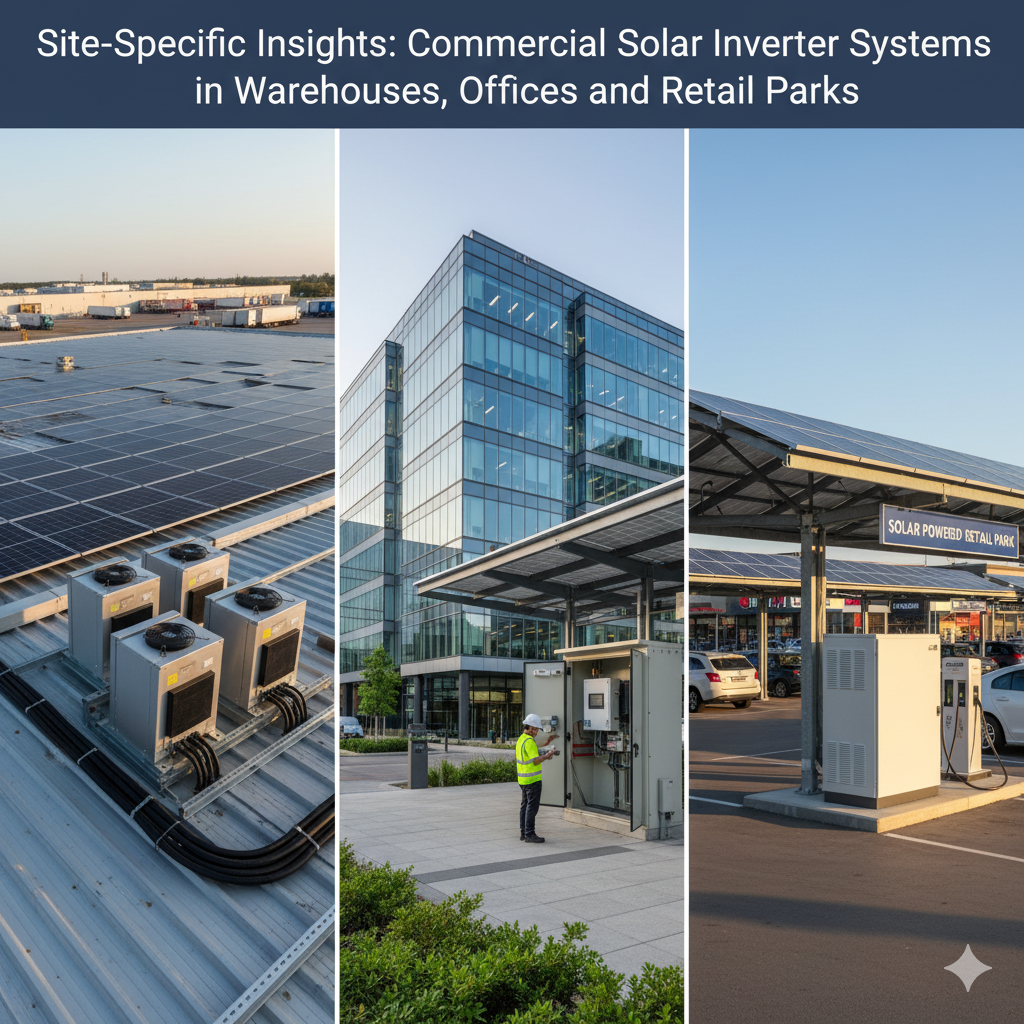
The Challenge: One Product, Three Very Different Worlds
Designing a commercial solar inverter system isn’t about watts on paper—it’s about matching electrical logic to the rhythm of real buildings.
A warehouse demands raw durability and long cable efficiency; an office requires silence, aesthetics, and precise load tracking; a retail park needs flexible, multi-zone coordination between tenants, roofs, and EV chargers.
Each site introduces its own energy behaviour, structural limits, and compliance headaches. Ignoring those nuances often leads to underperformance or inflated costs later on.
The Engineering Logic Behind Site-Specific Inverter Design
Modern commercial inverters are more than DC-AC converters. They act as control hubs that balance generation, grid feedback, and consumption patterns. But the way they operate depends heavily on context:
| Factor | Warehouse | Office Building | Retail Park |
|---|---|---|---|
| Load Pattern | Daytime heavy loads (motors, conveyors) | Intermittent, HVAC-driven | Variable, tenant-dependent + EV charging |
| Roof Layout | Large flat surface, long DC runs | Fragmented, multiple azimuths | Multi-roof, canopy, or parking structures |
| Environmental Concern | Heat, dust, long cable losses | Noise, interior comfort | Coordination between multiple systems |
| Priority Metric | Durability + maintenance access | Noise + aesthetic integration | Scalability + real-time monitoring |
Understanding this logic ensures every inverter configuration fits not only the PV array, but also the daily rhythm of the facility.
Comparing Design Strategies: Centralized vs Distributed Architectures
| Architecture | Key Benefits | Limitations | Best For |
|---|---|---|---|
| Centralized Inverter System | Simplified control, lower CAPEX per watt | High downtime risk, limited scalability | Warehouses & utility-scale sites |
| String Inverter System | Modular, flexible, fast troubleshooting | Slightly higher upfront cost | Offices, distributed retail roofs |
| Hybrid/Storage-Integrated System | Backup capability, peak shaving, EV support | Requires advanced management software | Retail parks & mixed-load facilities |
In practice, many projects adopt a hybrid layout—centralized units for main roofs, string units for shaded or irregular segments.
This mix balances operational resilience with installation cost efficiency.
Solving Real-World Problems: What Matters by Site Type
1. Warehouses — Durability Meets Distance
Warehouses often feature 10,000+ m² of rooftop space. Long DC cable runs can trigger voltage drops, while heat buildup affects performance.
Solution:
-
Opt for 1500 V string inverters to minimize loss and increase string length.
-
Ensure IP66 or NEMA 4X protection for dust resistance.
-
Mount inverters at ground level for easy maintenance access.
Result: Less time on roofs, fewer service interruptions, longer operational lifespan.
2. Office Buildings — Precision, Quiet Operation, and Smart Aesthetics
Unlike industrial zones, office environments demand silent, compact, and visually discreet solutions. Roofs are smaller and irregularly shaped.
Solution:
-
Use multi-MPPT string inverters to handle partial shading and variable tilt angles.
-
Prioritize fan-less or low-noise cooling (< 60 dB).
-
Integrate with building management systems (BMS) for real-time energy tracking.
Result: Optimized performance without compromising comfort or design integrity.
3. Retail Parks — Multi-Zone Energy with EV Integration
Retail parks combine multiple tenants, open canopies, and growing EV charging loads. Energy demand fluctuates throughout the day.
Solution:
-
Choose hybrid inverters with DC-coupled storage to balance PV production and EV load peaks.
-
Enable independent MPPT zones per building for tenant-level metering.
-
Deploy smart monitoring dashboards with energy-sharing logic.
Result: Coordinated energy flow across zones, reduced grid dependency, future-proof scalability.
Practical Selection Framework
| Key Criteria | What to Prioritize | Engineering Rationale |
|---|---|---|
| Voltage Platform | 1500 V for large roofs; 1000 V for small distributed sites | Minimizes cable loss and BOS cost |
| Cooling Method | Natural or forced-air depending on site dust level | Ensures thermal stability in hot zones |
| Monitoring | String-level analytics and cloud dashboards | Early fault detection saves O&M cost |
| Grid Compliance | Reactive power control + LVRT/HVRT | Meets local utility regulations |
| Hybrid Capability | DC-coupled battery integration | Enables peak shaving and load shifting |
| Maintenance Access | Ground or façade-mounted design | Simplifies inspection and replacement |
When planning across multiple properties, standardize on inverter platforms that share firmware and communication protocols—this makes remote monitoring and spare-part management much simpler.
Field Experience: What Engineers Learn the Hard Way
-
Oversizing Isn’t Always Efficiency: Adding 30% inverter margin doesn’t mean more generation—just higher cost. Always calculate clipping ratio by irradiance and orientation.
-
Cable Quality Matters: In warehouses with 150+ m cable runs, using undersized conductors reduces lifetime efficiency by up to 3–5%.
-
Maintenance Should Be Designed, Not Reacted To: Pre-install service access paths and ventilation in inverter enclosures—most downtime happens because access is difficult.
-
Noise Standards Are Real: In urban office projects, local codes often restrict outdoor inverter noise levels to below 65 dB.
FAQs
Q1: Which inverter type suits projects with both office and warehouse spaces?
A modular string inverter architecture works best. It allows scaling by area while maintaining consistent monitoring and firmware.
Q2: How can retail parks handle different tenants’ energy bills?
Use inverters supporting multi-channel metering or connect to an energy management platform (EMS) that allocates energy production per circuit.
Q3: What’s the recommended maintenance schedule?
Monthly remote diagnostics, quarterly firmware updates, and annual visual inspections of cabling and cooling fans.
Q4: Are hybrid inverters cost-effective for commercial users?
Yes—especially when electricity tariffs fluctuate or EV loads exist. Hybrid systems reduce peak demand costs and provide resilience during grid faults.
The Takeaway: Adapt the System, Not the Spec Sheet
The most successful commercial solar projects don’t use “standard kits.” They design for the real environment—where sunlight, dust, tenants, and workloads change every hour.
A warehouse values uptime. An office values silence. A retail park values flexibility.
When the inverter system acknowledges these realities, ROI improves naturally—not through marketing, but through engineering precision.
At ThlinkSolar, our inverter systems are designed with these differences in mind—tailored for industrial roofs, office buildings, and complex commercial networks.
Learn more at ThlinkSolar or reach our engineering team via the contact page.