Built for the Elements: Why Dustproof Solar Inverters Are Critical
Dust is one of the most underestimated threats to solar performance.
Inverters — the heart of energy conversion — can lose efficiency or even fail if dust blocks airflow, coats heat sinks, or corrodes internal boards.
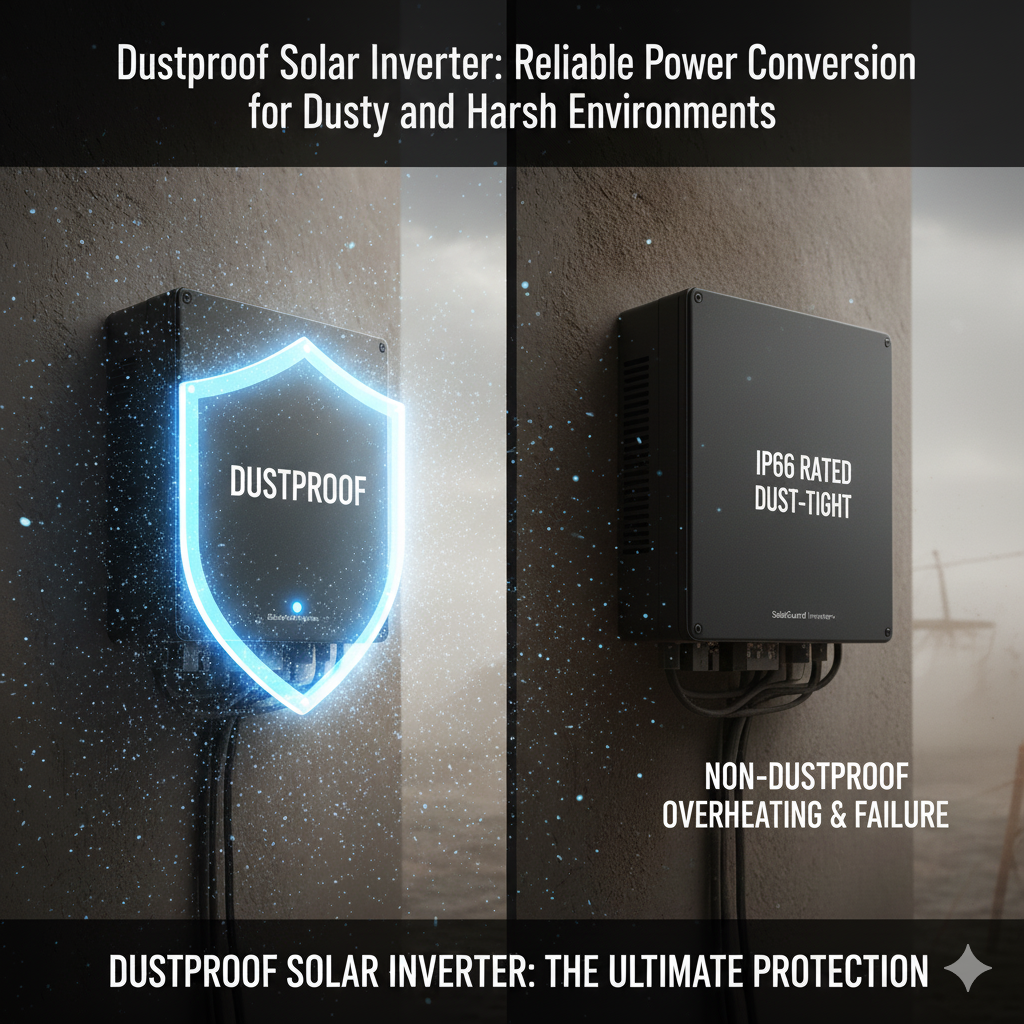
That’s where the dustproof solar inverter proves its worth.
Engineered with sealed enclosures and thermal optimization, it keeps airborne particles out and performance stable in harsh environments like factories, farms, and deserts.
How Dustproof Engineering Works
A dustproof inverter relies on mechanical design more than software. Its resilience is defined by the IP (Ingress Protection) standard, which measures protection against solids and liquids.
| IP Rating | Dust Resistance | Typical Use Case |
|---|---|---|
| IP54 | Limited dust ingress allowed | Indoor factories |
| IP65 | Completely dust-tight | Outdoor industrial zones |
| IP66+ | Sealed against high-pressure air and dust storms | Deserts and mines |
Inside, the inverter uses multi-layer filtration, sealed connectors, and conformal PCB coatings.
Even under continuous dust storms or machinery exhaust, these systems keep the power conversion rate above 95%.
Industrial Design Highlights
-
Sealed Aluminum Enclosure – Prevents micro-particle ingress.
-
Hydrophobic Filters – Maintain airflow while trapping dust.
-
Conformal PCB Coating – Protects electronics from fine particulates.
-
Passive Cooling Design – Fanless models eliminate dust intake entirely.
-
Anti-Corrosion Treatment – Ensures durability in cement or textile factories.
According to IEA-PVPS Task 13 studies, dust accumulation can reduce inverter efficiency by up to 12% annually without proper sealing systems — a loss preventable through IP65+ protection.
Source: IEA-PVPS Task 13 – PV System Performance Reports
Where Dustproof Inverters Make a Difference
| Environment | Challenge | Benefit |
|---|---|---|
| Desert Solar Farms | Fine sand and high wind load | IP66+ sealing prevents particle ingress |
| Cement & Mining Facilities | Airborne powder & vibration | Fanless structure ensures stable cooling |
| Agricultural Sites | Dust and humidity mix | Protective coating resists micro-corrosion |
| Industrial Warehouses | Heavy air pollution | Consistent efficiency over long hours |
In IRENA’s Renewable Power Generation Report (2023), installations in dusty climates achieved 25% longer inverter lifespan using sealed models with hydrophobic air membranes.
Source: IRENA – Renewable Power Generation Costs 2023
Thermal Stability & Maintenance
Dustproof design isn’t only about sealing — it’s about temperature balance.
A completely sealed inverter must still dissipate heat effectively.
Most high-grade units use extruded aluminum cooling fins, graphite thermal pads, and smart temperature sensors to stabilize operation.
A 2024 MDPI Sensors report found that fanless dustproof inverters maintained stable operation 30% longer than fan-cooled models in high-particulate environments.
Source: MDPI Sensors – Inverter Efficiency Study 2024
| Parameter | Fanless Dustproof | Conventional Fan-Cooled |
|---|---|---|
| Efficiency (Ambient 45°C) | 94.5% | 90.8% |
| Maintenance Interval | 24 months | 6 months |
| Noise Level | < 35 dB | > 60 dB |
| Dust Accumulation | Minimal | High |
Selection Guide: Choosing the Right Dustproof Inverter
When selecting a dustproof solar inverter, prioritize structural and environmental compatibility over wattage alone:
✅ IP Rating – Minimum IP65 for outdoor, IP66 for desert or mines.
✅ Cooling Method – Fanless passive systems reduce dust intake.
✅ Material – Aluminum alloy or coated steel preferred.
✅ Certifications – IEC 62109, CE, and RoHS for industrial use.
✅ Maintenance – Ensure easy exterior cleaning and indicator visibility.
For off-grid desert or rural plants, pair the dustproof inverter with solar combiner boxes featuring sealed cable glands to maintain total system integrity.
Common Questions
Q1: Can dustproof inverters operate in humid environments?
Yes, most IP65+ inverters are both dust and moisture resistant. Verify dual-rated models (IP65/IP66).
Q2: How often should these inverters be cleaned?
Quarterly inspection and light surface cleaning are usually enough. Internal cleaning isn’t required.
Q3: Is fanless better than fan-cooled in dusty regions?
Yes. Fanless designs avoid suction of particulate matter, reducing failure risk.
Q4: Can these be used in agricultural zones?
Absolutely. They’re ideal for grain mills, barns, and solar irrigation setups.
Engineering Reliability for Harsh Terrains
The dustproof solar inverter is the unsung hero of sustainable infrastructure — delivering consistent, long-life performance in the harshest industrial and natural environments.
At ThlinkSolar, we engineer inverters tested for desert durability, vibration resistance, and thermal endurance — ensuring reliability where it matters most.
Explore more at ThlinkSolar or contact our engineers via the Contact Us page.