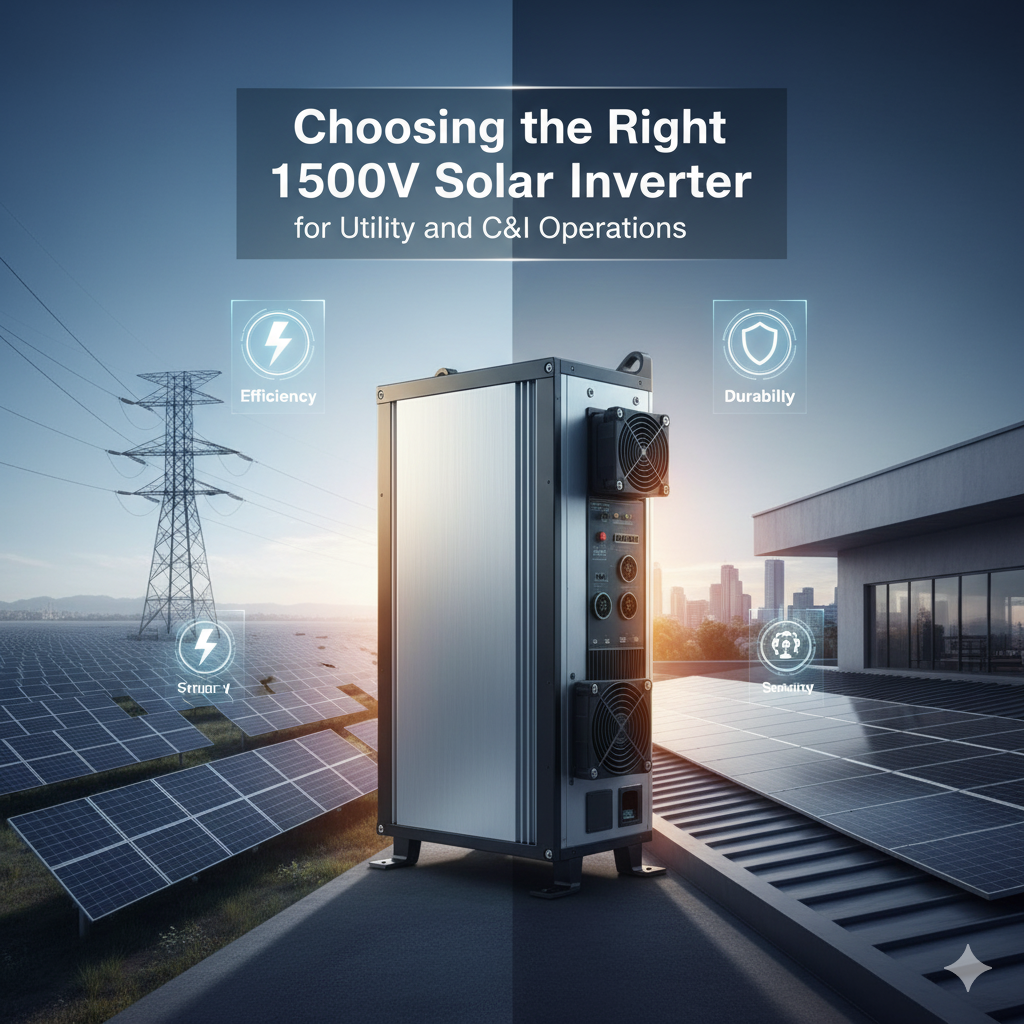
Choosing the Right 1500V Solar Inverter for Utility and C&I Operations
Understanding Why 1500V Systems Became the Standard
The shift toward 1500V solar inverter systems isn’t a marketing trend—it’s a response to real field demands. Large-scale solar farms and commercial buildings have outgrown the electrical limits of 1000V systems. Increasing the DC voltage to 1500V allows engineers to extend string length, reduce cabling losses, and achieve greater overall efficiency.
For utility operators, this means fewer connection points and simplified maintenance. For commercial users, it reduces BOS (balance of system) costs and enables rooftop or carport systems to produce more energy within limited space.
Key Factors That Determine the Right Inverter Choice
Choosing the correct 1500V inverter involves more than matching nameplate capacity. Each project environment introduces unique electrical, thermal, and operational challenges.
1. Environmental Conditions
-
High temperature zones → Require advanced cooling systems and low-derating performance.
-
Dusty or coastal environments → Favor IP65+ or corrosion-resistant enclosures.
-
High altitude installations → Need derating curves and internal pressure equalization designs.
2. Grid Conditions & Regulations
-
For unstable or weak grids, select inverters with strong LVRT/HVRT compliance.
-
Ensure compatibility with local grid codes and remote communication protocols.
-
Integrated reactive power and frequency control are key for grid support.
3. Load Type & Operational Model
-
Continuous industrial loads → Favor inverters with high surge tolerance.
-
Hybrid or storage-ready systems → Require bidirectional communication and DC coupling options.
-
Variable production profiles (factories, logistics hubs) → Need high MPPT granularity for stable output.
Comparing Centralized vs. String 1500V Inverters
| Feature | Central Inverter | String Inverter |
|---|---|---|
| Capacity Range | >1 MW | 50–300 kW |
| Maintenance | Centralized; fewer units | Modular; easy swap |
| Failure Impact | Higher (system-wide) | Localized (one unit) |
| Cooling Type | Forced air or liquid | Natural or fan-based |
| Use Case | Utility-scale projects | C&I rooftops, carports, microgrids |
Decision Tip:
For utility-scale plants, centralized inverters remain more cost-effective.
For distributed commercial systems, modular string inverters simplify installation and O&M.
Real-World Scenarios and System Design Insights
1. Factory Rooftops & Industrial Parks
Factories operating heavy machinery during daytime benefit from 1500V systems that minimize cable loss and maintain consistent output during voltage fluctuations.
Example: A 2MW automotive parts plant in Southeast Asia reduced BOS costs by 9% after upgrading to 1500V string inverters with multiple MPPT inputs.
2. Commercial Complexes & Business Parks
Inverter selection should prioritize low noise levels, safety certifications, and integration with building management systems (BMS).
Hybrid-ready 1500V models also allow future battery integration, ensuring long-term ROI.
3. Utility-Scale Solar Farms
Large ground-mounted systems in desert or plateau regions rely on liquid-cooled 1500V inverters to handle temperature swings.
These setups often integrate SCADA monitoring, allowing grid operators to optimize dispatch and detect anomalies in real time.
Practical Selection Checklist
Selecting a 1500V solar inverter for large-scale or commercial projects involves more than checking specifications—it’s about aligning performance, cost, and environmental fit. The table below summarizes the real-world decision matrix used by project engineers and procurement teams.
| Evaluation Dimension | What to Consider | Expert Recommendation |
|---|---|---|
| System Scale | Rated capacity and array layout directly affect the inverter’s string configuration and MPPT count. | For systems >500 kW, use 1500 V models with multi-MPPT architecture to minimize mismatch losses. |
| Environment & Climate | Heat, humidity, and dust dramatically affect derating and component life. | Look for IP66 / C5 corrosion resistance, fanless cooling, and wide thermal range (-30 °C – +60 °C). |
| Grid Type & Stability | Weak or fluctuating grids can trigger inverter trips or reactive power loss. | Choose units with dynamic LVRT/HVRT support, adjustable PF, and anti-islanding certification. |
| Operation & Maintenance | Accessibility and downtime determine lifecycle cost. | Prioritize string-level monitoring, hot-swap modules, and remote firmware updates. |
| Hybrid Readiness | Energy storage integration is increasingly essential. | Select models with DC coupling, BMS communication ports, and hybrid control logic. |
| Compliance & Warranty | Certification ensures faster project approval and lower insurance risk. | Verify IEC 62109 / UL 1741 / CE / RoHS compliance and ≥10-year service support. |
Common Buyer Questions
Q1: Can 1500V inverters be used in rooftop systems?
Yes, as long as safety clearances and insulation standards (IEC 62109, UL 1741) are met.
Q2: What’s the difference between hybrid-ready and standard 1500V inverters?
Hybrid-ready units include DC-coupling and communication ports for battery integration, ideal for C&I users planning future upgrades.
Q3: Are there additional safety concerns with 1500V operation?
Not with certified equipment—modern units feature enhanced insulation, arc-fault detection, and surge protection.
Q4: How can I estimate cost savings from 1500V systems?
Typically, BOS savings range from 5–10% depending on project scale and layout.
Why Utility and C&I Developers Are Transitioning Now
The 1500V inverter marks a maturity point in solar design: a balance of higher efficiency, lower maintenance, and better scalability. Whether deployed across industrial rooftops or 100MW utility farms, it enables longer operational lifespan and reduced LCOE.
ThlinkSolar continues to develop inverters tailored to diverse installation conditions—factory rooftops, logistics centers, and grid-connected solar farms—ensuring long-term reliability and compliance with global standards.
For detailed project guidance or custom configurations, visit ThlinkSolar’s homepage or reach our technical team through the Contact Us page.