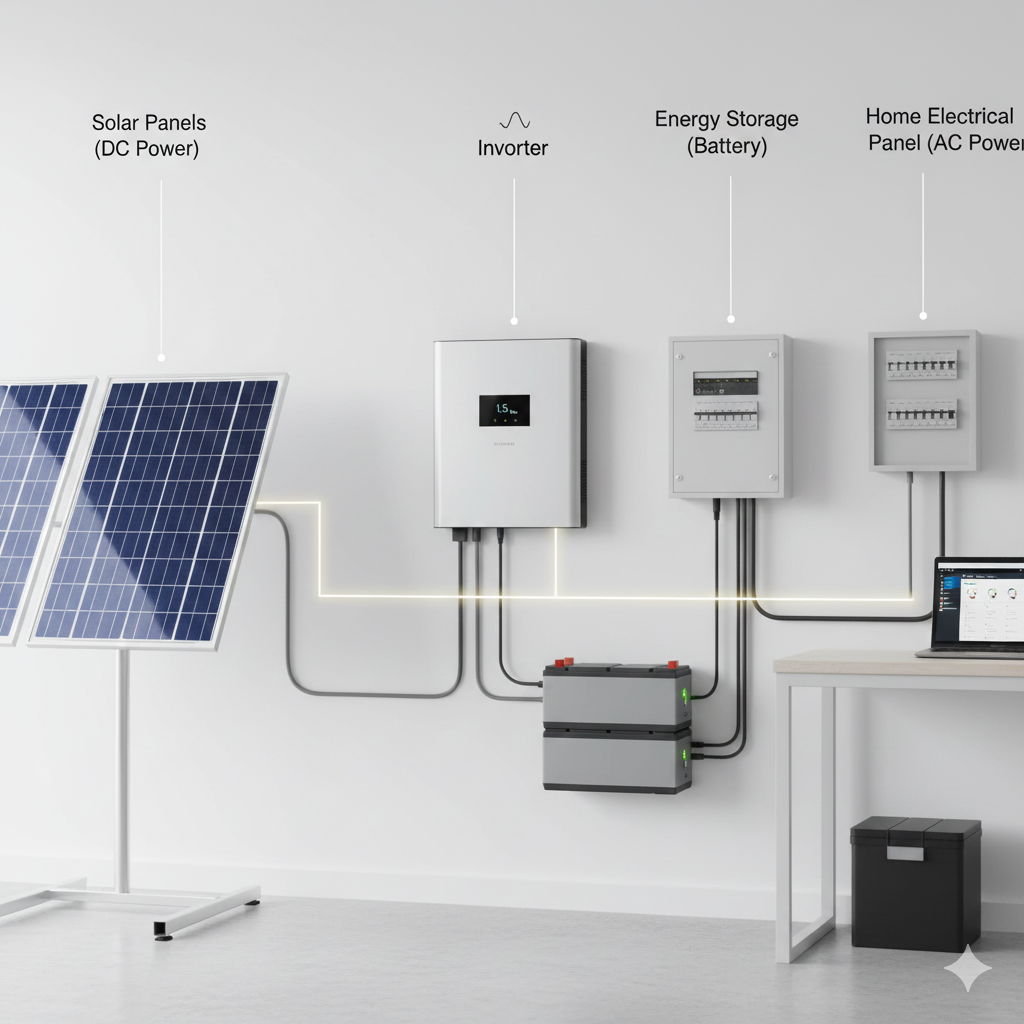
Solar Inverter Working Principle and System Integration: How Smart Power Conversion Works
A solar inverter is more than an electrical device—it is a precision control system that converts, synchronizes, and manages renewable power. Understanding its working principle and how it integrates within a broader energy system helps project developers, installers, and engineers design efficient and reliable solutions.
Thlinksolar, as a global inverter manufacturer, focuses on high-efficiency conversion, grid compatibility, and modular integration—ensuring every watt of solar energy is delivered safely and effectively to users.
The Core Working Principle of a Solar Inverter
At the heart of every solar inverter working principle lies one key operation: converting direct current (DC) from solar panels into alternating current (AC) that appliances and grids can use.
This conversion involves several coordinated stages:
-
DC Input Stage – Solar panels generate variable voltage DC depending on sunlight intensity.
-
Boost Conversion Stage – The inverter adjusts voltage through DC-DC boost circuits for consistent input.
-
Inversion Stage – Power transistors (IGBTs or MOSFETs) rapidly switch current flow to produce AC output.
-
Filtering Stage – Inductors and capacitors smooth out ripples, creating a pure sine wave.
-
Synchronization Stage – The inverter aligns frequency (50/60 Hz) and phase with the utility grid.
Modern designs employ digital signal processors (DSPs) to monitor these processes in microseconds, ensuring high efficiency and low total harmonic distortion (THD <3%).
According to the International Energy Agency (IEA), inverter performance improvements have contributed to over 40% of total solar efficiency gains over the past decade.
Maximum Power Point Tracking (MPPT): The Brain of Efficiency
MPPT technology is what differentiates a smart inverter from a simple one.
It continuously adjusts the inverter’s input voltage to ensure panels operate at their maximum power point, regardless of light or temperature changes.
How MPPT Works:
-
Monitors real-time panel voltage and current
-
Detects the voltage where power output (V×I) is maximized
-
Dynamically adjusts DC-DC converter duty cycles
-
Reacts instantly to shading, cloud cover, or partial string mismatch
A study by the National Renewable Energy Laboratory (NREL) found that effective MPPT algorithms can improve annual energy yield by 6–12%, particularly in distributed residential systems where panel conditions vary.
Thlinksolar integrates dual and triple MPPT trackers in its inverters, allowing multiple array orientations and ensuring each string performs optimally throughout the day.
Grid-Tied and Off-Grid System Integration
Integration determines how the inverter interacts with the rest of the energy system.
| System Type | Power Flow | Energy Source | Application Scenario |
|---|---|---|---|
| Grid-Tied | Two-way (export & import) | Solar + grid | Urban homes, offices, schools |
| Off-Grid | One-way (independent supply) | Solar + battery | Remote or rural areas |
| Hybrid | Smart switching between solar, grid, and battery | Solar + grid + storage | Areas with unstable grid |
In hybrid systems, inverters manage automatic power routing. When solar power exceeds load demand, excess energy charges batteries; when solar falls short, the inverter switches to grid or generator backup.
This seamless switching occurs in milliseconds, ensuring uninterrupted operation.
Communication and Control: The Digital Nerve System
Modern solar inverter system integration relies on intelligent communication protocols such as RS485, Wi-Fi, Modbus TCP/IP, or CAN Bus.
These enable remote monitoring, firmware upgrades, and fault diagnostics—crucial for large-scale deployments.
Smart integration capabilities include:
-
Real-time power data visualization via apps or dashboards
-
Auto grid disconnection during voltage fluctuations
-
Remote control of battery charge/discharge scheduling
-
Integration with smart meters for demand response management
This digital layer allows solar inverters to function as part of the Internet of Energy (IoE), enabling predictive maintenance and performance optimization.
Thermal Management and Structural Integration
Thermal stability directly influences inverter lifespan.
Thlinksolar adopts dual-stage cooling systems—a combination of natural convection and intelligent fan control—to maintain component temperature below 65°C, even during peak loads.
In multi-inverter installations, systems are integrated into string combiner boxes and AC distribution panels, ensuring equal load sharing and coordinated protection.
For industrial applications, modular parallel connections allow scalability up to megawatt-level arrays.
The International Renewable Energy Agency (IRENA) emphasizes that intelligent thermal and electrical integration can extend inverter service life by 20–25%, reducing downtime in utility-scale plants.
Safety, Standards, and Compliance
Safety features built into inverters include:
-
Anti-Islanding Protection – Automatically disconnects from the grid during outages.
-
Ground Fault Detection – Prevents leakage currents and shock hazards.
-
Surge Protection – Guards against lightning and transient spikes.
-
Temperature Derating – Reduces output under extreme heat to protect internal components.
Thlinksolar’s inverters comply with IEC 62109, CE, and TÜV standards, ensuring compatibility with international grid codes.
Integration into Energy Storage and Smart Grids
Inverters now play a central role in energy storage systems (ESS) and smart grid frameworks.
When paired with lithium or LFP batteries, hybrid inverters manage charge cycles based on time-of-use pricing, maximizing economic return.
At grid level, advanced models support reactive power compensation and voltage regulation, helping utilities maintain system stability.
This integration bridges distributed generation and centralized infrastructure, marking a major step toward next-generation energy networks.
The Path Forward: Smarter, Scalable Power Control
As solar energy becomes mainstream, inverter systems are evolving into multi-function energy managers.
AI-based predictive analytics, modular scaling, and blockchain-based grid settlements are shaping the next wave of solar control technology.
Thlinksolar continues to refine its inverter platforms to meet global demand for flexible, connected, and resilient energy systems—empowering homes, enterprises, and industries to achieve greater energy independence and efficiency.
For technical consultation or project collaboration, visit Thlinksolar.com or contact our engineering team.