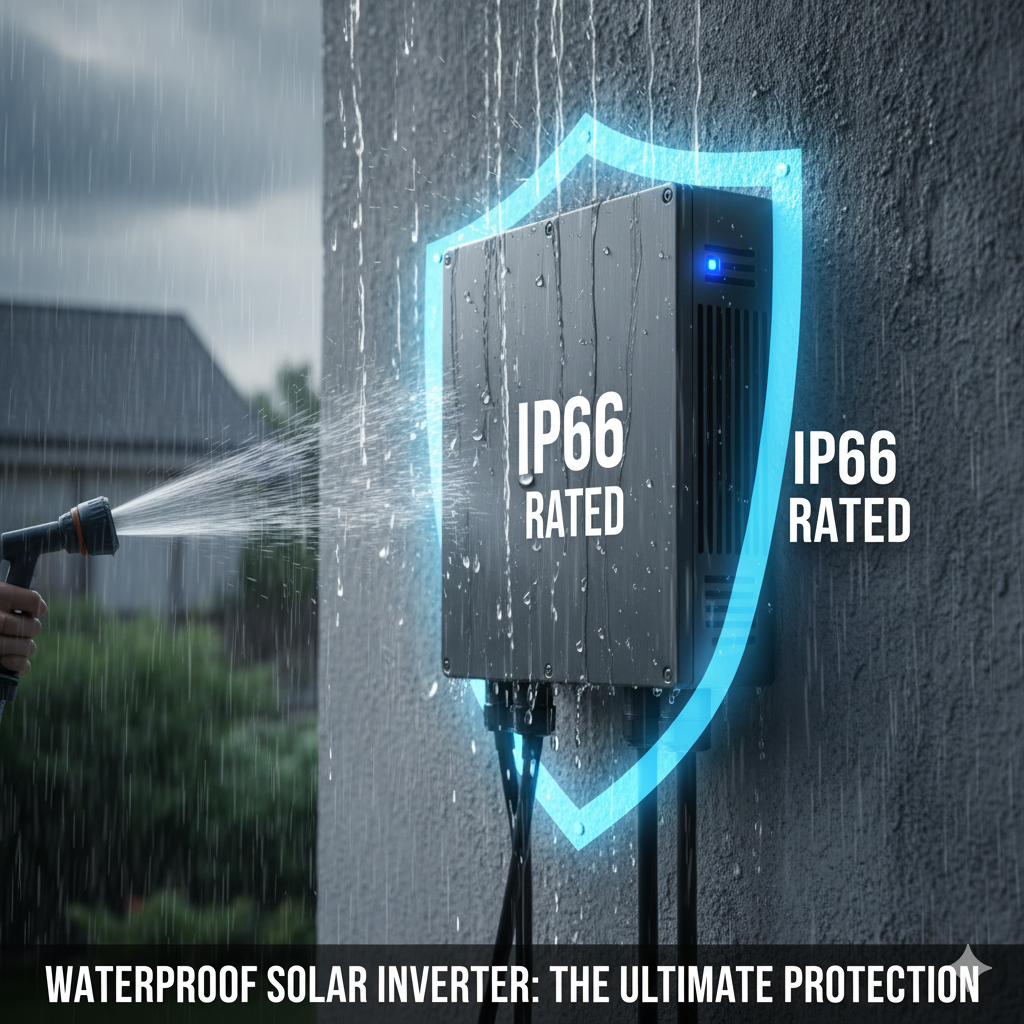
Defying the Elements: Why Waterproof Solar Inverters Matter
Solar installations rarely live in perfect conditions. Rain, dust, salt spray, and temperature shifts all threaten inverter reliability.
That’s where the waterproof solar inverter steps in — a system built to convert energy efficiently while resisting environmental damage.
For rooftop plants, rural grids, or coastal farms, this technology ensures uninterrupted performance even when nature turns unpredictable.
Understanding Waterproof Ratings (IP Standards)
The waterproof level of a solar inverter is defined by its Ingress Protection (IP) rating, an international standard describing dust and moisture resistance.
| Rating | Description | Ideal Environment |
|---|---|---|
| IP54 | Limited dust ingress, splash-resistant | Indoor or sheltered area |
| IP65 | Fully dust-tight, resistant to low-pressure water jets | Outdoor roof systems, mild rain |
| IP66–IP67 | High-pressure water and submersion tolerance | Coastal / agricultural / flood-prone zones |
A typical IP65 solar inverter uses sealed connectors, conformal PCB coatings, and weatherproof aluminum enclosures, enabling safe outdoor operation year-round.
Real-World Scenarios: Where Waterproof Solar Inverters Excel
| Environment | Challenge | Solution |
|---|---|---|
| Rooftop Installations | Constant UV and rainfall | UV-resistant enclosures with IP65 sealing |
| Agricultural Fields | High dust and humidity | Hydrophobic coating prevents corrosion |
| Coastal Regions | Salt fog and air corrosion | Anti-oxidation alloy casings |
| Remote Solar Farms | Temperature extremes | Thermal control + adaptive cooling fans |
As per IRENA’s 2023 Renewable Power Report, over 68% of distributed PV systems in tropical or coastal regions require inverters rated IP65 or above for reliability.
Source: IRENA – Renewable Power Generation Costs 2023
Internal Design Innovations
Waterproof doesn’t just mean sealed. A modern waterproof inverter integrates multiple engineering safeguards:
-
Conformal PCB Coating – Protects circuits from moisture and dust.
-
Pressure Equalization Valves – Prevent condensation in sealed chambers.
-
Hydrophobic Filters – Maintain airflow while blocking water ingress.
-
Aluminum Die-Cast Housing – Prevents corrosion and UV degradation.
-
Wide Operating Range (-25°C to +60°C) – Ensures global climate compatibility.
An MDPI 2024 Sensors Journal study confirmed that properly sealed inverter housings reduce annual maintenance events by up to 40%, especially in humid climates.
Source: MDPI Sensors – Inverter Efficiency Using PV Element Parameters (2024)
Performance Stability in Extreme Conditions
In IEA-PVPS Task 13’s technical report, weatherproof inverter systems showed a 12–18% longer service life compared to standard enclosures, thanks to reduced thermal fatigue and oxidation stress.
Source: IEA-PVPS Task 13 – Performance of New PV System Designs
| Test Condition | IP65 Inverter | Standard Inverter |
|---|---|---|
| Dust Exposure (ISO 20653) | No degradation | Partial heat sink clogging |
| Rain Simulation (IEC 60529) | No water ingress | Minor leakage |
| Temperature Cycling | Stable output ±2% | Efficiency drop 6% |
| Lifespan Projection | 10–12 years | 7–8 years |
The result: higher uptime and lower maintenance cost, especially in exposed installations.
Practical Selection Guide
When choosing a waterproof solar inverter, consider the following checklist:
✅ IP Rating: Minimum IP65 for fully outdoor exposure.
✅ Enclosure Material: Prefer aluminum or coated steel.
✅ Thermal Control: Look for adaptive cooling or fanless design.
✅ Connector Type: MC4 / weatherproof gland cable entry.
✅ Certifications: IEC 62109, UL 1741, CE, and RoHS compliance.
For coastal or desert projects, opt for IP66+ fanless inverters—these eliminate dust intake and minimize maintenance frequency.
Common Questions
Q1: Can waterproof inverters be submerged in water?
IP65 and IP66 units resist water jets, not submersion. For flood-prone sites, use IP67 or elevated mounting.
Q2: Do waterproof designs affect cooling?
Fanless units rely on heat sinks and thermal conduction. Efficiency remains stable if properly ventilated.
Q3: Is waterproofing worth the extra cost?
Yes. Over 10 years, lower maintenance and downtime offset initial costs significantly.
Q4: Can these be used for marine or floating PV systems?
Yes, provided they meet IP67 and anti-corrosion certification (IEC 60068-2).
A Foundation for Long-Term Reliability
The waterproof solar inverter transforms environmental challenges into sustainable performance.
By merging durability with efficiency, it safeguards energy stability in every season and region.
At ThlinkSolar, our waterproof inverter lineup—ranging from compact 20V hybrid systems to 1500V industrial units—is engineered for resilience, ensuring consistent output in the harshest conditions.
Learn more at ThlinkSolar or contact our experts via the Contact Us page.