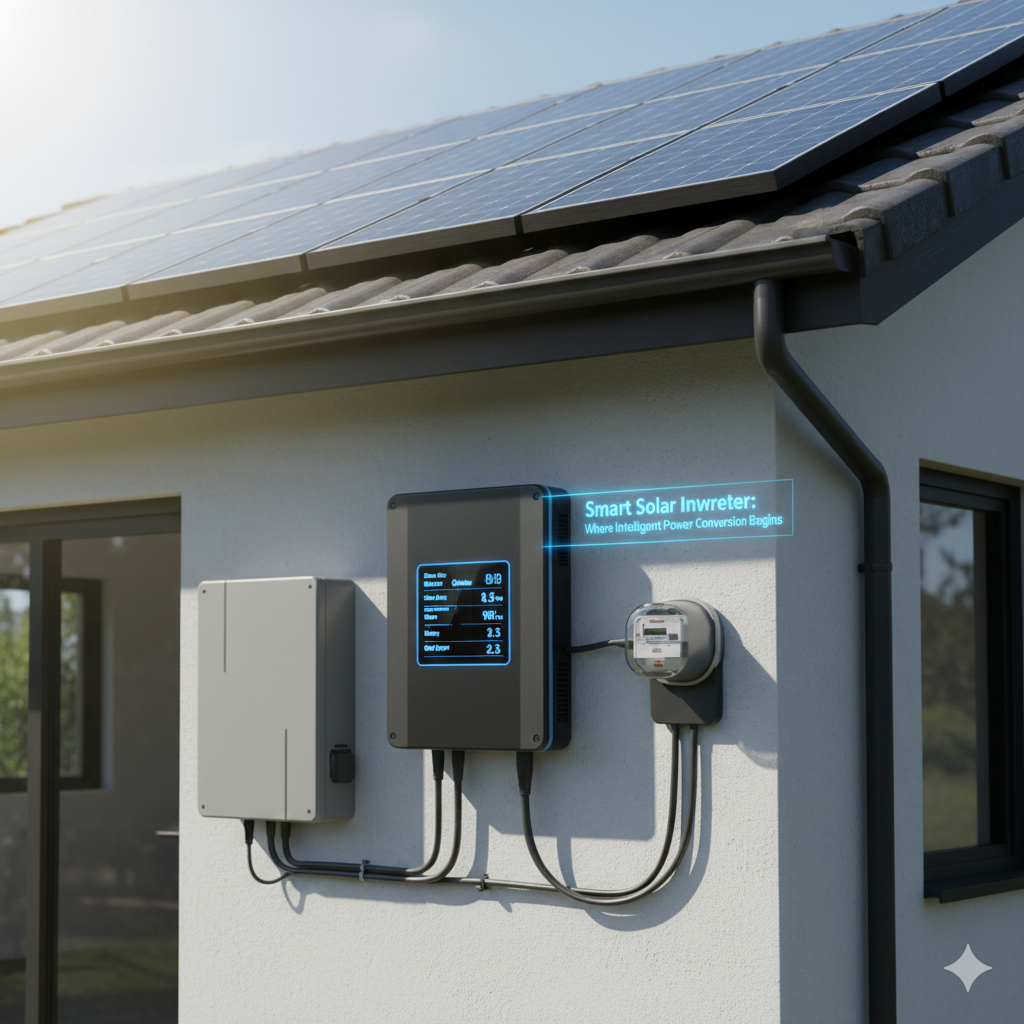
Smart Solar Inverter Factory: Where Intelligent Power Conversion Begins
Behind every stable solar energy system lies a precise piece of equipment—the inverter. A smart solar inverter factory like Thlinksolar’s is where technology, engineering, and automation converge to produce devices that convert raw solar energy into reliable, optimized power.
Thlinksolar’s manufacturing facilities combine AI-driven production control, multi-stage testing, and international quality standards, ensuring each inverter delivers consistent output even under the toughest field conditions.
From Design to Production: A Digital Manufacturing Ecosystem
A true smart factory doesn’t just build hardware—it creates a feedback loop between design, testing, and operation.
Thlinksolar’s facility integrates a digital twin system, replicating every production stage in a virtual environment to simulate load, temperature, and performance outcomes before final assembly.
Core manufacturing flow includes:
-
Component Selection: Semiconductor chips, IGBTs, and heat sinks are sourced from Tier-1 suppliers.
-
PCB Assembly: Automated surface-mount technology (SMT) lines ensure accuracy at micron-level tolerances.
-
Firmware Integration: MPPT algorithms and protection logic are flashed via cloud-based controllers.
-
Thermal Calibration: Each inverter undergoes a 60-minute heat-load simulation.
-
Functional Testing: Real-time load cycles replicate field conditions for up to 10,000 operational scenarios.
This end-to-end digitalization ensures that data from production informs future design refinement, minimizing human error and improving yield rate above 99.2%.
Smart Features That Define Next-Generation Inverters
Every unit produced in Thlinksolar’s smart solar inverter factory carries embedded intelligence for system-wide optimization:
| Feature | Description | Advantage |
|---|---|---|
| MPPT Tracking | Real-time voltage-current optimization | Increases solar output efficiency |
| Wi-Fi & RS485 Communication | Enables remote monitoring and diagnostics | Simplifies maintenance |
| AI Fault Prediction | Machine learning models detect early warning signals | Prevents costly downtime |
| Thermal Optimization | Adaptive cooling based on internal sensors | Extends lifespan and performance |
| Hybrid Compatibility | Works with solar, grid, and battery systems | Supports off-grid and ESS setups |
The integration of digital intelligence throughout the hardware allows Thlinksolar inverters to adapt automatically to weather variations, grid fluctuations, and load changes without manual recalibration.
Factory-Level Quality Control and Global Standards
Quality assurance at Thlinksolar follows a zero-defect principle, supported by a multi-stage inspection process aligned with CE, TUV, and ISO certifications.
-
Incoming Material Test (IMT): Ensures all semiconductor and PCB materials meet electrical conductivity and insulation benchmarks.
-
Automated Optical Inspection (AOI): Detects soldering imperfections using 3D imaging.
-
Burn-In Test: Each inverter runs at 110% rated load for 8 hours under elevated temperature.
-
Electromagnetic Compatibility Test (EMC): Confirms stability in high-interference environments.
-
Final Performance Audit: Verifies power factor, waveform distortion, and conversion efficiency.
These processes enable Thlinksolar to maintain less than 0.3% return rate across international markets.
Integration with Sustainable Manufacturing
The smart solar inverter factory also reflects Thlinksolar’s sustainability goals.
Energy used during manufacturing is partially sourced from on-site solar panels, and advanced water-cooled testing benches recycle 90% of the thermal load discharge.
Packaging materials are recyclable, and all process waste is handled through ISO 14001-certified partners—underscoring a commitment to both energy innovation and environmental responsibility.
The International Renewable Energy Agency (IRENA) recognizes sustainable manufacturing as a key enabler for achieving net-zero targets within the renewable energy supply chain—an area where Thlinksolar leads by example.
Applications and Export Coverage
Thlinksolar’s smart solar inverters power systems in over 40 countries, covering:
-
Residential rooftops: Compact wall-mounted hybrid systems.
-
Commercial facilities: Multi-string installations up to 100kW.
-
Industrial microgrids: Integrated ESS and three-phase setups.
-
Agricultural and off-grid systems: Dust-proof, temperature-resistant units for remote environments.
By focusing on flexible inverter design and local adaptation, Thlinksolar supports OEM and ODM cooperation worldwide, tailoring products to each market’s grid requirements.
According to the National Renewable Energy Laboratory (NREL), localized inverter design can increase energy yield by up to 12% by optimizing algorithms for region-specific irradiation patterns.
What Makes a Smart Inverter Factory Truly “Smart”?
A smart factory isn’t defined by machines alone—it’s about decision automation.
Thlinksolar employs:
-
AI predictive maintenance to detect production anomalies in real time.
-
IoT sensors monitoring humidity, vibration, and thermal drift across assembly lines.
-
Centralized MES (Manufacturing Execution System) for live production analytics.
These digital processes align with IEA guidelines for Industry 4.0 adoption, helping bridge renewable technology with intelligent automation.
Conclusion
The future of solar manufacturing depends on intelligent systems that merge precision engineering with automation. A smart solar inverter factory like Thlinksolar’s demonstrates how innovation in production directly translates to reliability in the field.
By combining real-time testing, AI analytics, and sustainable operations, Thlinksolar not only delivers high-efficiency inverters but also defines what modern renewable manufacturing should look like—smart, scalable, and sustainable.
For OEM cooperation or factory tours, visit Thlinksolar.com or reach our production team through Contact Us.