Compact Hybrid Systems, Continuous Power
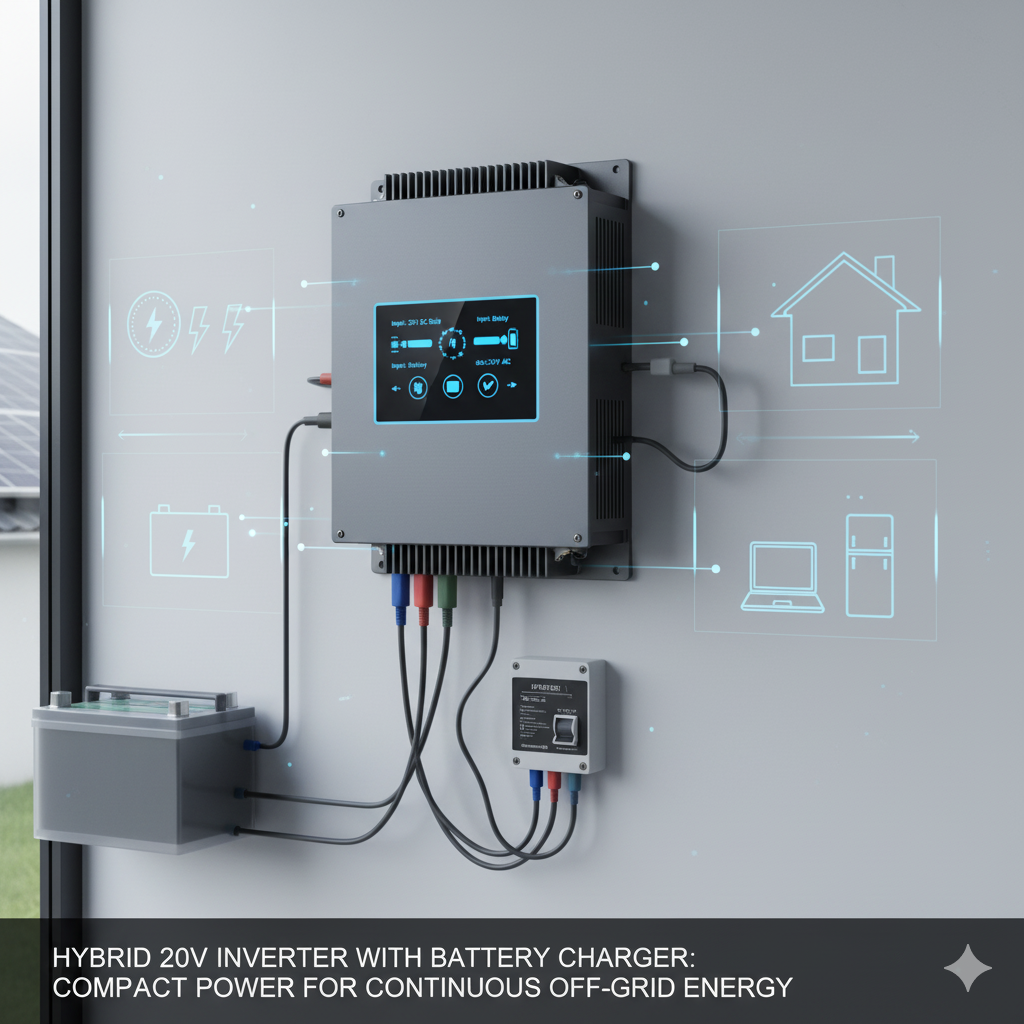
In off-grid environments, reliability is everything. The hybrid 20V inverter with battery charger integrates energy generation, conversion, and storage into one intelligent device.
Unlike conventional setups where multiple components handle separate functions, this hybrid unit combines MPPT charge control, inverter conversion, and battery management—creating a compact yet powerful solution for rural lighting, portable energy kits, and small industrial units.
How Hybrid 20V Inverters Operate
The hybrid 20V inverter is a dual-function energy core. It draws DC power from solar panels and simultaneously charges a connected battery bank, ensuring stable power availability even when sunlight fades.
| Function | Description | Engineering Value |
|---|---|---|
| PV Input | Accepts DC from solar panels (18–22 V) | Converts to AC power and manages charging simultaneously |
| Battery Charger | Charges 12 V / 24 V LiFePO₄ or gel batteries | Prevents overcharging and deep discharge |
| Inverter Output | Provides stable 220 V AC or 110 V AC | Runs small equipment or lighting circuits |
| MPPT Controller | Tracks max solar output | Increases system efficiency by 10–15 % |
This configuration minimizes wiring loss and component mismatch, delivering compact hybrid efficiency with up to 95 % conversion rate.
Engineering Advantages
-
All-in-One Architecture – Combines charger + inverter + MPPT controller.
-
Seamless Transition – Instantly switches between solar and battery input.
-
Compact & Modular – Ideal for portable or semi-fixed systems.
-
Battery Health Management – Balances charge cycles to extend lifespan.
-
Low Idle Consumption – Reduces standby drain for remote setups.
According to IEA-PVPS Task 13’s report on compact hybrid designs, single-module inverter-charger systems reduce installation cost by up to 25 % and increase reliability in small PV networks.
Source: IEA-PVPS Task 13 – Performance of New PV System Designs
Where Hybrid 20V Inverters Excel
| Scenario | System Need | Hybrid Advantage |
|---|---|---|
| Rural Agriculture | Stable power for pumps / lighting | Built-in charger supports night use |
| Telecom Shelters | Reliable DC backup | Maintains signal uptime during cloud cover |
| Small Workshops | Constant tool operation | Smooth switching prevents brownouts |
| Portable Energy Kits | Lightweight + plug-and-play | Compact inverter-charger replaces multi-unit setup |
As IRENA highlights in its 2024 report, hybrid low-voltage systems are becoming a key enabler for distributed energy adoption in developing regions.
Source: IRENA – Renewable Power Generation Costs in 2023
Technical Comparison: Hybrid vs. Conventional Inverter + Charger
| Feature | Hybrid 20V Unit | Separate Inverter + Charger |
|---|---|---|
| Architecture | Integrated MPPT + charging + conversion | Separate modules + extra cabling |
| Efficiency | 93 – 95 % | 85 – 90 % |
| Cost / Installation | Lower | Higher (Labor + wiring) |
| Maintenance | Unified interface | Multi-point failure risk |
| Best Use Case | Small off-grid or portable systems | Large custom PV arrays |
MDPI Sensors (2024) confirmed that hybrid inverter-charger configurations show 30 % lower thermal loss in small-scale applications.
Source: MDPI Sensors – Inverter Efficiency Using PV Element Parameters (2024)
Installation & Configuration Tips
-
Use short DC runs to minimize voltage drop (< 2 %).
-
Choose aluminum IP65 enclosures for outdoor use.
-
Match battery chemistry (LiFePO₄ / Gel) with charging curve.
-
Add fuse + reverse-polarity protection for safety.
-
For multi-unit systems, link via RS-485 or CAN bus for load management.
Common Questions
Q1: Can this hybrid 20V inverter run directly from solar without battery?
Yes, but voltage fluctuations can affect load stability; a small buffer battery is recommended.
Q2: Is MPPT necessary for a 20V system?
Absolutely. MPPT tracking improves charging efficiency by 10 – 15 % in low-irradiance conditions.
Q3: Can I expand later with more batteries or panels?
Yes, most hybrid models support parallel PV inputs and up to two battery banks.
Q4: What’s the recommended maintenance interval?
Annual inspection of cooling fans and terminal tightness is sufficient for systems below 1 kW.
Sustainable Engineering in a Compact Form
The hybrid 20V inverter with battery charger represents a shift toward integrated, intelligent energy management.
By uniting generation and storage, it delivers energy autonomy to places where large systems are impractical.
At ThlinkSolar, we engineer each hybrid inverter for reliability across environments—from mobile units to permanent off-grid installations.
Learn more about our solutions at ThlinkSolar or contact our team through the Contact Us page.