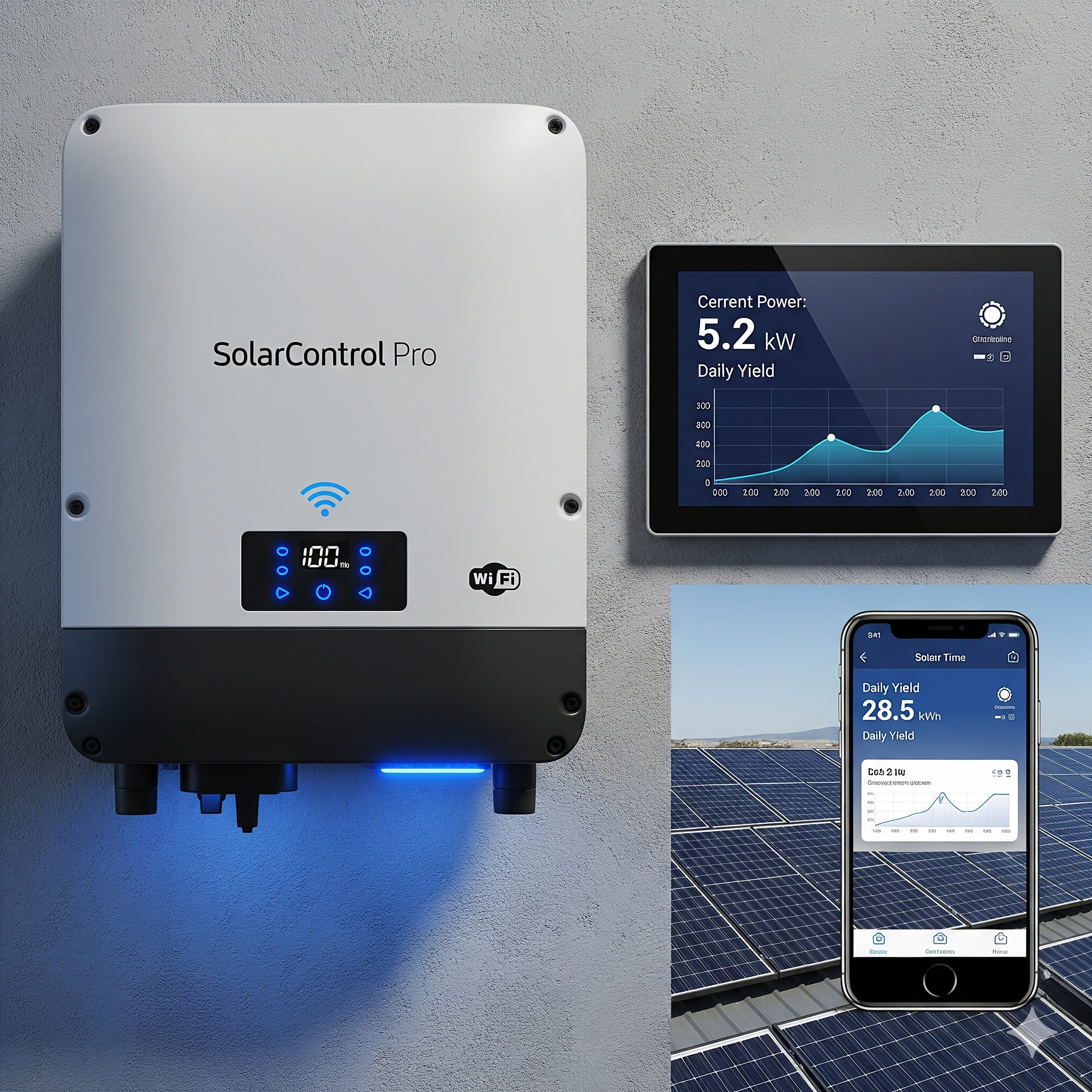
Connected Power: How WiFi-Enabled Inverters Are Redefining Solar Control
The evolution of solar energy is no longer only about panels and storage — it’s about how users interact with energy.
A WiFi-enabled solar inverter bridges that gap, turning solar systems into connected, controllable, and measurable assets.
For homeowners and small business operators, it means visibility — every watt of power generated, consumed, or stored is now in the palm of your hand.
Instead of depending on technicians for basic diagnostics, WiFi-enabled systems provide instant data, allowing decisions that improve performance, reduce costs, and extend system lifespan.
Smart Connectivity Meets Everyday Simplicity
Unlike older models that required manual inspection, WiFi-enabled inverters integrate sensors, network modules, and app-based control.
-
Real-Time Monitoring – View daily and historical energy performance through mobile or web dashboards.
-
Remote Control – Adjust charging modes, grid settings, or system shutdown remotely.
-
Performance Alerts – Receive automatic notifications for voltage fluctuations or efficiency drops.
-
Data Insights – AI-based analytics help identify long-term optimization opportunities.
| Feature | Function | Value for Users |
|---|---|---|
| WiFi Module | Connects inverter to router or IoT network | Enables 24/7 access anywhere |
| App Dashboard | Tracks generation and consumption trends | Transparency and accountability |
| Auto Alerts | Fault and status notifications | Preventive maintenance |
| Cloud Storage | Retains performance history | Supports warranty and ROI analysis |
A 2024 MDPI Energies study shows that systems using WiFi monitoring achieved 8–12% higher operational efficiency through proactive maintenance and optimization.
Source: MDPI Energies – Smart PV Systems Monitoring 2024
A Smarter Way to Manage Energy
For Homeowners
WiFi-enabled inverters turn solar energy into an interactive home experience:
-
See how much solar power your appliances use in real time.
-
Schedule energy storage or export during off-peak hours.
-
Detect anomalies like underperforming panels early.
These features make homeowners active participants in managing their sustainability footprint.
For Small Businesses
Retail stores, cafés, and workshops gain efficiency without technical complexity.
Owners can monitor power use during working and non-working hours, ensuring equipment operates within optimal energy thresholds.
Example: A bakery in Southeast Asia used a 5 kW WiFi-enabled inverter to monitor usage and cut grid reliance by 28% within six months.
Technical Advantages and Reliability
| Parameter | WiFi-Enabled Inverter | Traditional Inverter |
|---|---|---|
| Monitoring Access | Mobile + Cloud | Local only |
| Maintenance | Predictive | Reactive |
| Response Time | Instant | Delayed |
| Efficiency Optimization | AI-Assisted | Manual |
| User Experience | Interactive | Passive |
Beyond convenience, the design includes industrial-grade encryption (TLS 1.3) and firmware updates over-the-air, ensuring long-term reliability and cybersecurity — crucial for connected homes and SME operations.
Investment Perspective: Control Equals Value
Every decision in solar investment is about maximizing output and minimizing downtime.
With WiFi-enabled inverters, the ROI comes not just from energy production, but also from the ability to:
-
Prevent unplanned maintenance.
-
Reduce technician visits.
-
Optimize load management based on live data.
According to IRENA’s Technology Outlook 2024, connected inverters improve asset performance by up to 15% and reduce maintenance costs by 20–30% in decentralized systems.
Source: IRENA Technology Outlook 2024
Practical Buying Considerations
✅ Check App Ecosystem – Ensure compatibility with Android, iOS, and PC dashboards.
✅ WiFi Range – At least 20–30 meters line-of-sight for stable transmission.
✅ Firmware Updates – Automatic OTA upgrades for software reliability.
✅ Data Backup – Cloud or local SD storage for long-term tracking.
✅ Integration – Optional Bluetooth or LAN for hybrid connectivity.
When scaling to multiple branches or buildings, prioritize models supporting multi-device accounts and centralized dashboards.
Common Questions
Q1: Does WiFi monitoring increase inverter cost significantly?
Only marginally (~5–10%), but the long-term operational savings outweigh the premium.
Q2: What if my internet connection fails?
Data is cached locally and auto-synced once the connection is restored.
Q3: Can I share monitoring access with multiple users?
Yes, most platforms allow multi-user logins with permission control.
Q4: How secure is the remote data?
Modern inverters follow ISO 27001 and TLS 1.3 standards for encrypted communication.
Power in Your Pocket
The WiFi-enabled solar inverter gives control back to users — whether it’s a household tracking daily consumption or a café owner optimizing energy bills.
It embodies the shift from static energy systems to interactive, data-driven sustainability.
At ThlinkSolar, our WiFi-enabled inverter range combines high efficiency, predictive analytics, and smart monitoring — helping users simplify energy management and maximize returns.
Learn more at ThlinkSolar or contact our experts via the Contact Us page.