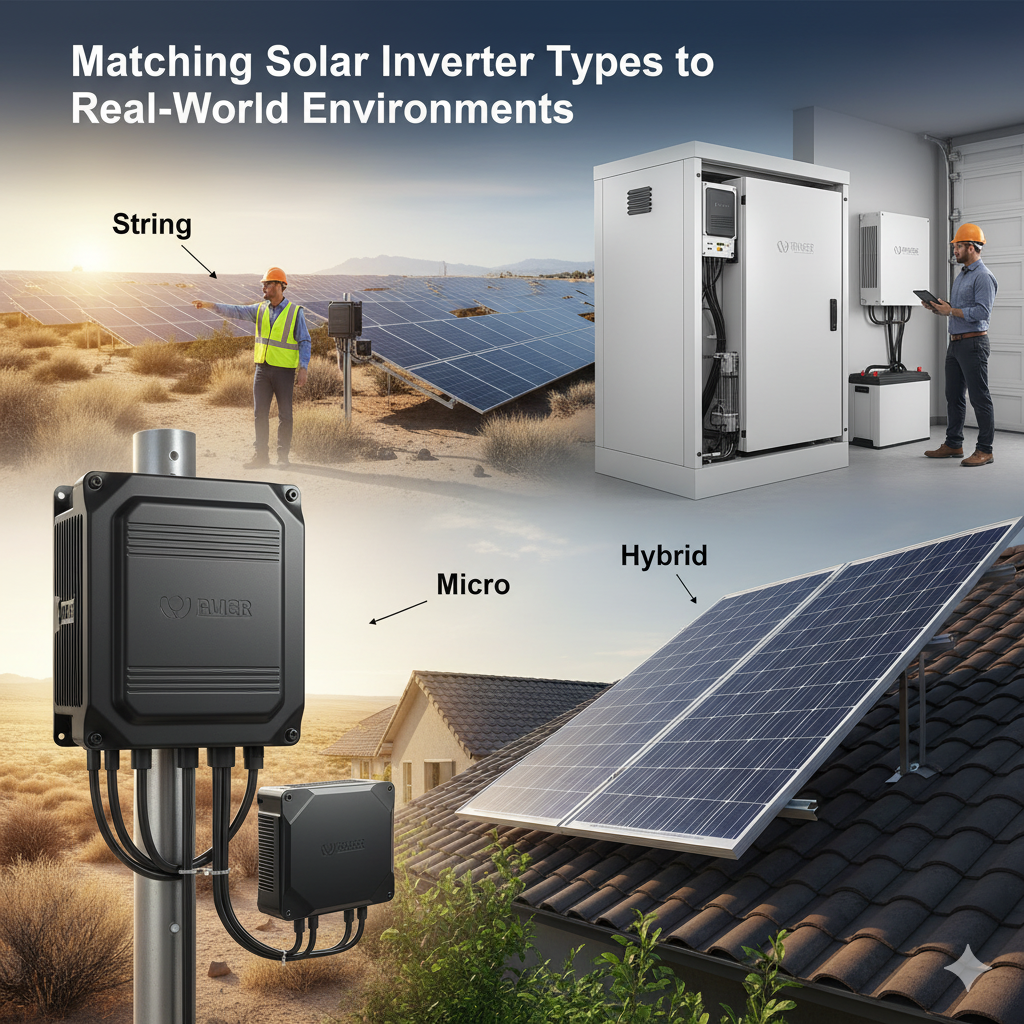
The Real Question Isn’t “Which Inverter?”—It’s “Where Will It Work?”
Solar inverters don’t fail because of design flaws—they fail because they’re misplaced.
A 1500 V central inverter may dominate a desert solar farm, yet overheat in a tight utility room. A micro inverter thrives on shaded rooftops but struggles on megawatt sites.
The key isn’t to pick the most expensive or most efficient unit—it’s to match technology to environment, balancing output, safety, and lifecycle economics.
The Four Core Inverter Types and Their Operating Logic
| Inverter Type | Core Function | Typical Scale | Voltage Platform | Best Use Case |
|---|---|---|---|---|
| String Inverter | Connects multiple panels in series; DC→AC per string | Small to medium | 600–1500 V | Residential, C&I rooftops |
| Central Inverter | Aggregates power from multiple strings | Utility-scale | 1000–1500 V | Large solar farms, factories |
| Micro Inverter | Converts power at panel level | Small | < 1000 V | Shaded rooftops, complex layouts |
| Hybrid Inverter | Integrates PV + battery + grid | Variable | 48–600 V | Backup systems, EV-ready sites |
This simple table hides deep engineering trade-offs. The real performance difference lies in installation conditions, load behavior, and ambient stress factors like heat, humidity, and dust.
How Environment Defines Performance
1. Open Industrial Roofs & Solar Farms — Central or High-Voltage String Inverters
In vast, sun-drenched spaces where panels face identical orientation, central or 1500 V string inverters dominate.
They simplify wiring, reduce BOS costs, and achieve > 98 % efficiency.
To maintain reliability:
-
Place inverters near combiner boxes to minimize DC losses.
-
Use liquid cooling or IP66 housing for hot, dusty climates.
-
Enable smart monitoring for long cable runs.
2. Urban Rooftops with Partial Shading — Micro or Multi-MPPT String Inverters
In cities, no roof is perfect. Shadows from water tanks, walls, or antennas affect output.
Micro inverters or multi-MPPT string inverters mitigate this by optimizing each panel or array individually.
They’re quieter, safer, and easier to expand—but costlier per watt.
Best suited for:
-
Apartment blocks
-
Small offices
-
Schools or hospitals with complex roof layouts
3. Commercial Buildings with Variable Loads — Hybrid Inverters
Modern offices, retail stores, and small factories often face fluctuating power demand.
Hybrid inverters combine solar generation + battery storage + grid feed, maintaining energy stability during spikes or outages.
Key engineering tips:
-
Choose DC-coupled designs for better round-trip efficiency.
-
Integrate with load-management software for demand prediction.
-
Match inverter-to-battery communication protocols (BMS/EMS) to avoid mismatch issues.
4. Coastal, Desert, and High-Humidity Sites — Sealed or Liquid-Cooled Systems
Environmental stress can make or break inverter lifespan.
In coastal zones, salt corrosion damages heat sinks; in deserts, sand infiltration shortens fan life.
IP66+ or liquid-cooled string/central inverters deliver long-term reliability by isolating electronics from dust and moisture.
Select:
-
Aluminum or coated steel housings
-
Fanless designs where possible
-
Internal thermal balancing to avoid derating under > 45 °C
Practical Selection Framework
| Condition | Inverter Type | Design Priority | Engineering Reason |
|---|---|---|---|
| Uniform irradiation, large site | Central / 1500 V String | Efficiency & BOS reduction | Simplifies long runs |
| Shaded urban rooftops | Micro / Multi-MPPT String | Output consistency | Individual optimization |
| Hybrid energy needs | Hybrid | Energy independence | PV + storage integration |
| Harsh climates | IP66 / Liquid-cooled | Durability | Dust & heat protection |
| Grid instability | Hybrid / String with grid-support | Reliability | Voltage/frequency control |
Real-world selection is never linear—projects often blend inverter types for optimal control and redundancy.
Common Buyer Questions
Q1: Why not just buy the most efficient inverter?
Because efficiency on paper doesn’t guarantee uptime. Environmental derating, maintenance access, and heat load often matter more.
Q2: Can hybrid inverters run entirely off-grid?
Yes, if sized properly with sufficient storage and auto-transfer capability. But ensure compliance with local grid codes if grid-tied.
Q3: Are micro inverters worth it for small commercial sites?
Yes, especially when roof shading or tenant segmentation complicates string layouts. They deliver better yield and simpler maintenance.
Q4: How often should inverters be serviced?
Typically once per year for inspections, plus continuous remote monitoring for anomaly alerts.
The Bottom Line: Right Technology, Right Place
Solar inverters aren’t universal devices—they’re environment-specific instruments of efficiency.
Choosing the right one is less about chasing specs and more about understanding where it will live—under dust, wind, noise limits, or variable load conditions.
When properly matched, the inverter becomes invisible—quietly ensuring every kilowatt counts.
We design inverter systems precisely for their environment—from hybrid units for office and retail energy balance to high-voltage models for industrial parks and utility fields.
Learn more at ThlinkSolar or reach our engineering team via the Contact Us page.