The Unforgiving Nature of Data Center Power Demand
In today’s digital economy, milliseconds of downtime can mean thousands of dollars lost. Data centers depend on continuous, stable power to run servers, cooling systems, and networking hardware around the clock.
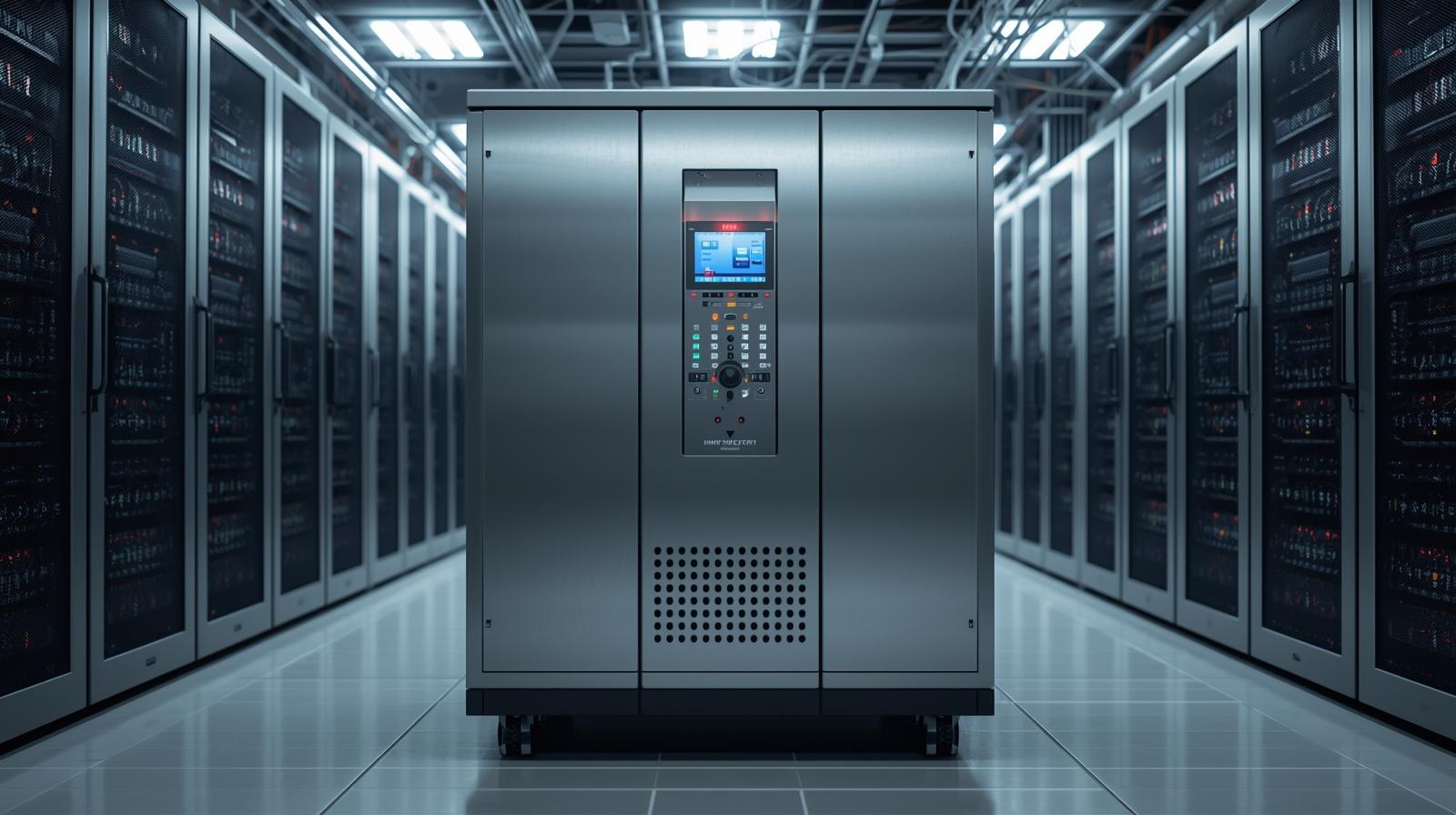
Grid instability, voltage fluctuations, or equipment surges can lead to service interruptions and hardware failure. To prevent this, every facility integrates an industrial-grade inverter — a system that ensures power continuity and clean conversion between grid, solar, and storage inputs.
Beyond backup, the modern inverter plays a central role in reducing energy waste and improving Power Usage Effectiveness (PUE) — a key benchmark for sustainable data operations.
Inside the System: How Inverters Keep Data Centers Running
Unlike standard power supplies, data center inverters operate in high-density, mission-critical environments. They ensure seamless transitions between energy sources without data loss or power distortion.
| Component | Function | Impact |
|---|---|---|
| AC/DC Converter Stage | Converts input to stable DC | Supports server racks & UPS batteries |
| Inverter Bridge | Converts DC back to clean AC | Ensures constant frequency & voltage |
| Energy Storage Integration | Connects to lithium or LFP batteries | Provides instant power during outages |
| Control & Monitoring Module | Manages loads, temperature, and redundancy | Prevents overcurrent and thermal stress |
This architecture guarantees zero-interruption performance — meaning data centers can maintain uptime even during grid faults or generator switchover delays.
Engineering Priorities in Data Center Inverters
Data center inverters must meet far stricter standards than residential or commercial units. Their core engineering principles include:
-
High Conversion Efficiency (≥98%) — reduces operational costs and heat load.
-
Low Total Harmonic Distortion (THD < 2%) — ensures clean power for sensitive electronics.
-
Redundant Parallel Design — supports N+1 backup configurations for zero downtime.
-
Hot-Swappable Modules — allow maintenance without shutting down the system.
-
Real-Time Monitoring via SNMP/Modbus — integrates with Data Center Infrastructure Management (DCIM) systems.
-
Compliance with IEC, UL, and ISO Standards — ensuring international deployment readiness.
Together, these features create a power environment as reliable as the servers they protect.
Hybrid Power Integration: Solar and Storage for Sustainable Data Centers
Energy efficiency has become a strategic goal for every global data operator. Hybrid inverter systems now make it possible to blend renewable generation with traditional grid power.
| Energy Source | Role in Data Center | Benefit |
|---|---|---|
| Grid Power | Base load supply | Primary and most stable input |
| Solar Energy via Inverter | Peak-hour offset | Cuts utility bills and carbon footprint |
| Battery Storage | Short-term backup | Enables instant failover |
| Diesel Generator (optional) | Long-term emergency power | Extended runtime assurance |
According to IRENA (2024), hybrid inverter setups in mid-sized data centers can reduce total energy cost by 25–40% and lower carbon emissions by up to 50 tons per year, depending on regional solar potential.
Where Inverters Safeguard Data Operations
-
Edge Computing Facilities
-
Compact inverter systems support distributed IT infrastructure close to users.
-
-
Enterprise Data Centers
-
Hybrid setups integrate rooftop solar to reduce dependency on expensive grid tariffs.
-
-
Colocation Centers
-
Redundant inverters maintain uptime across multiple tenants’ racks.
-
-
Hyperscale Data Hubs
-
Modular inverter systems allow scalable power distribution and load sharing.
-
-
Disaster Recovery Sites
-
Hybrid backup ensures continuous operations during blackouts or natural events.
-
In each case, inverter reliability directly defines service quality and SLA compliance.
Matching Inverters to Data Center Scale
| Data Center Type | Typical Load Range | Recommended Inverter Features |
|---|---|---|
| Edge or Micro Data Center | 10–30 kW | Compact hybrid inverter, high power density |
| Mid-Tier Enterprise Facility | 50–200 kW | Parallel redundancy + battery interface |
| Hyperscale / Tier IV Facility | 500 kW–2 MW | Modular inverter arrays, N+1/N+2 configuration |
Tip: Always prioritize models with dual DSP control, EMI filters, and isolated communication interfaces to prevent signal interference in IT environments.
Frequently Asked Questions
Q1: Can solar inverters really support data centers?
Yes — when integrated as hybrid systems with grid and battery backup, they enhance energy security and reduce cost per kWh.
Q2: How is inverter reliability verified?
Through thermal testing, overload simulations, and compliance with IEC 62040-3 for UPS-grade performance.
Q3: What’s the expected service life?
Most high-quality inverters last 10–12 years, with periodic module replacements.
Q4: How fast can they switch power sources?
Typically within 5–10 milliseconds, fast enough to avoid system reboot or data loss.
Powering the Digital Future with Reliable Inverter Systems
As global data demand surges, uninterrupted power has become non-negotiable. Modern inverters bridge the gap between energy reliability, sustainability, and cost control — enabling data centers to perform continuously, efficiently, and responsibly.
At Thlinksolar, our inverter solutions are designed for mission-critical environments — offering hybrid adaptability, redundant architecture, and advanced monitoring systems that ensure total uptime and energy transparency.
To explore tailored inverter systems for your data center projects, visit our homepage or contact our engineering team through the contact page.