Power That Thinks Ahead: Inside the Smart MPPT Inverter Revolution
Traditional inverters work on fixed parameters — solar in, AC out.
But in regions with unstable grids or mixed energy sources, static systems fall short.
The smart MPPT inverter with dual input and auto switching changes that equation.
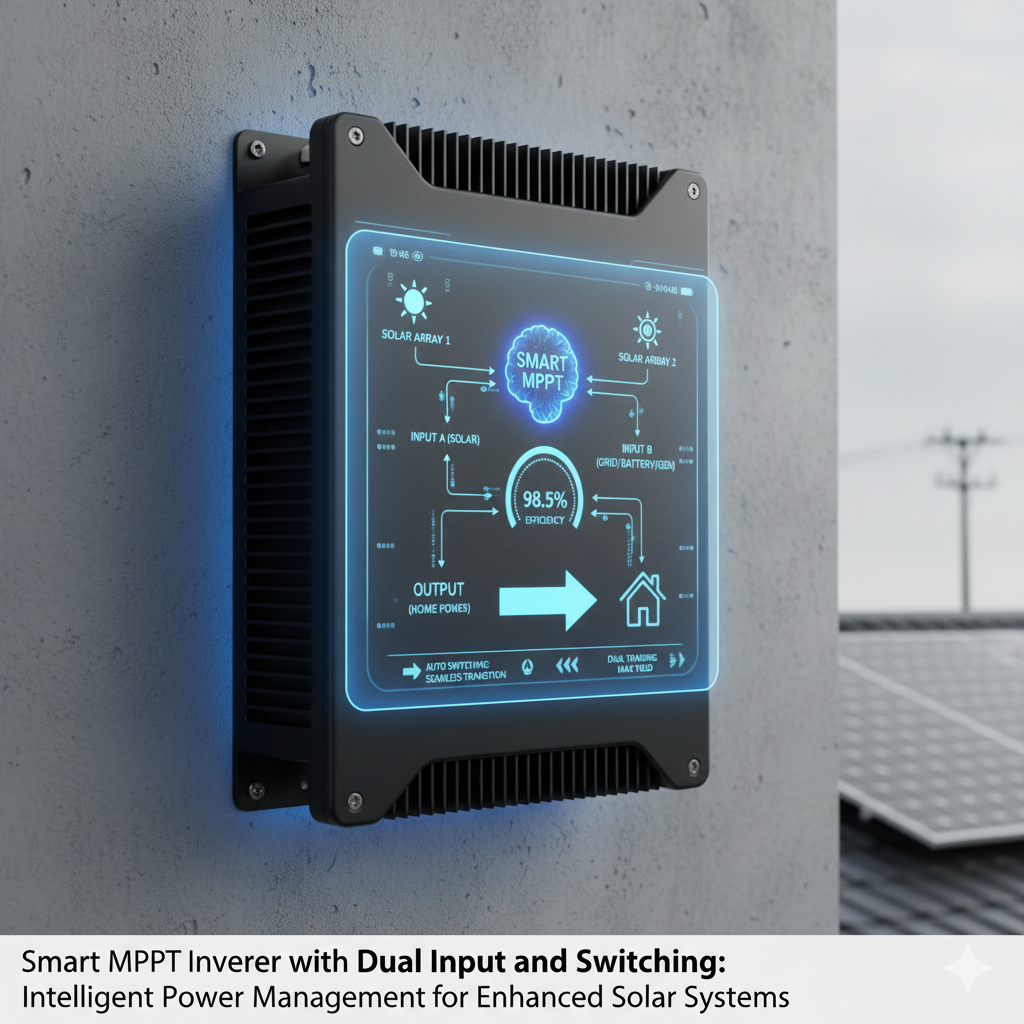
It’s not just an inverter; it’s an adaptive power manager capable of seamlessly switching between solar, grid, and battery inputs while maintaining maximum power point tracking (MPPT) efficiency.
For both homes and commercial users, this means one thing — no more interruptions, no wasted sunlight, and no manual switching.
Understanding Dual Input and Auto Switching
Dual input design means the inverter can simultaneously manage two independent DC sources, such as:
-
Solar Array Input (PV)
-
Battery Bank or Auxiliary DC Source
An intelligent MPPT controller monitors both lines, selecting the most efficient path for energy conversion.
| Feature | Function | Benefit |
|---|---|---|
| Dual Input | Accepts power from PV and battery simultaneously | Reduces downtime & energy loss |
| Auto Switching | Shifts between solar, grid, and battery | Prevents blackout or overload |
| Smart MPPT | Tracks maximum voltage/current ratio | Improves conversion efficiency by up to 25% |
The result is a system that predicts and adapts to energy fluctuations in real time — much like how adaptive braking systems enhance safety in vehicles.
The Engineering Behind Smart MPPT
The secret lies in algorithm-driven dynamic tracking.
Unlike conventional inverters that perform periodic sampling, smart MPPT systems use continuous variable tracking with predictive modeling.
According to MDPI Electronics (2024), adaptive MPPT algorithms achieved 98.4% energy conversion under irregular irradiance compared to 93% with static systems.
Source: MDPI Electronics – Advanced MPPT Algorithms 2024
Additionally, IEA PVPS Task 13 research found that inverters equipped with dual MPPT inputs reduce total harmonic distortion (THD) and enhance system stability under mixed load operations.
Source: IEA-PVPS Task 13 – Performance of New PV System Designs
Core Advantages
-
Seamless Energy Transition
No relay clicks or lag. Auto-switching happens within milliseconds, preventing supply gaps. -
Extended Battery Lifespan
Intelligent load management prevents deep discharge and optimizes charge cycles. -
Optimized Power Use
Dual MPPT inputs allow maximum utilization even under partial shading or cloud cover. -
Reduced Maintenance
Real-time diagnostics minimize failure prediction errors and improve service scheduling. -
Scalable Design
Works in small residential setups or large C&I hybrid installations.
| Parameter | Smart Dual Input MPPT | Conventional Inverter |
|---|---|---|
| Conversion Efficiency | 98.4% | 93.2% |
| Response Time | <20 ms | 200–300 ms |
| Source Flexibility | Solar + Battery + Grid | Solar only |
| Maintenance | Predictive | Manual |
| Lifecycle | 12+ years | 8 years |
Real-World Applications
| Environment | Power Source | Functionality |
|---|---|---|
| Rural Areas | PV + Battery | 24-hour power autonomy |
| Commercial Buildings | PV + Grid | Peak shaving and demand management |
| Telecom Towers | Battery + PV | Continuous uptime without manual switch |
| Industrial Zones | Grid + PV + Diesel Backup | Automated load balancing |
| Agricultural Sites | PV + Water Pump Battery | Smart irrigation control |
In IRENA’s Global Off-Grid Report (2023), hybrid MPPT systems reduced generator usage by 40% in rural electrification projects.
Source: IRENA – Renewable Power Generation Costs 2023
Practical Selection Guidelines
When choosing a smart MPPT inverter with dual input and auto switching:
✅ Check MPPT Channels — Minimum two independent trackers recommended.
✅ Evaluate Response Speed — Look for sub-50 ms switching time.
✅ Prioritize Efficiency — Above 97% conversion for hybrid systems.
✅ Ensure Communication Protocols — RS485 / WiFi / Modbus for remote control.
✅ Select Right Voltage Class — 12V/24V/48V for homes, 96V+ for commercial.
For factory-scale or telecom setups, prefer fanless designs with passive cooling — dust and vibration resistant.
Common Questions
Q1: What’s the difference between dual input and dual MPPT?
Dual input refers to two power sources; dual MPPT means two independent tracking circuits. A high-end inverter combines both.
Q2: Can it work without a battery?
Yes. Auto switching allows grid-solar operation without storage, ideal for daytime-heavy usage.
Q3: Does frequent switching affect performance?
No. Solid-state relays handle fast transitions with no mechanical wear.
Q4: What if both power inputs fail?
Smart control ensures a graceful shutdown to protect loads and batteries.
Smart Power, Seamless Control
The Smart MPPT Inverter with Dual Input and Auto Switching represents the evolution from passive conversion to intelligent power orchestration.
It’s the bridge between solar flexibility and industrial reliability.
At ThlinkSolar, we design hybrid inverters that integrate AI-driven MPPT, high-speed switching, and remote monitoring — engineered to keep businesses and communities powered without compromise.
Learn more on ThlinkSolar or contact us through the Contact Us page.