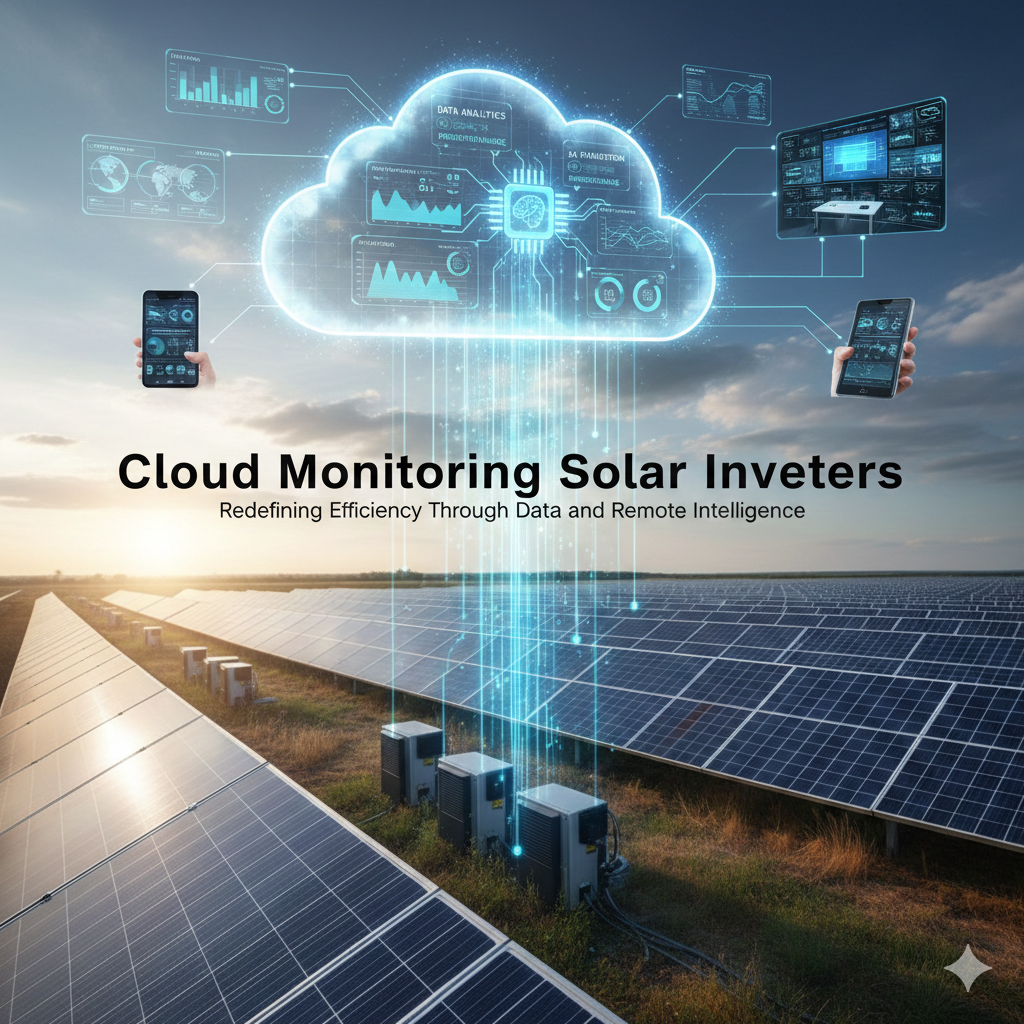
loud Intelligence Reshaping Solar Infrastructure
Energy infrastructures are no longer static power systems—they are dynamic, connected ecosystems. Cloud-monitored solar inverters represent this shift, turning every inverter into a data node that contributes to grid stability and asset intelligence.
As noted by the International Renewable Energy Agency (IRENA), systems equipped with remote analytics can lower maintenance costs by 30–40%, largely due to early fault prediction and continuous performance benchmarking.
The Architecture Behind Real-Time Solar Oversight
At the heart of these systems lies a secure data communication framework linking local hardware to centralized monitoring platforms.
Instead of periodic data logging, modern inverters stream live telemetry—voltage, temperature, current harmonics—to cloud analytics engines.
Key technical processes include:
-
Data Acquisition Layer: Sensors capture parameters across inverter stages.
-
Edge Communication Module: Converts raw data into encrypted packets.
-
Cloud Analytics Engine: Runs pattern recognition models to detect inefficiencies.
-
User Interface Layer: Displays actionable metrics for O&M engineers and EPC teams.
Through this architecture, stakeholders can track power output, efficiency curves, and degradation rates across multiple sites—whether on mobile devices or control rooms.
Comparative Evaluation: Legacy vs. Cloud-Connected Inverters
| Aspect | Conventional Systems | Cloud-Monitored Systems |
|---|---|---|
| Data Access | Manual or local logging | Real-time via encrypted web dashboard |
| Maintenance | Reactive and delayed | Predictive and scheduled |
| Firmware Updates | On-site service | Remote OTA management |
| Network Integration | Limited | Compatible with IoT, BMS, and SCADA platforms |
| Lifecycle Insight | Minimal | Continuous performance history and AI-driven insights |
This comparison reveals a shift from operation-based maintenance to data-driven asset management, helping integrators detect early-stage inefficiencies invisible to traditional tools.
Operational Applications Across Diverse Environments
Cloud-monitored solar inverters serve a wide spectrum of sectors where uptime and remote accessibility are mission-critical:
-
Warehouses and Logistic Parks: Centralized dashboards help coordinate multi-roof systems.
-
Hotels and Resorts: Monitor energy distribution across multiple zones while maintaining visual silence.
-
Manufacturing Plants: Balance on-site generation with fluctuating industrial load profiles.
-
Agricultural Irrigation Systems: Integrate solar pumping performance with water usage analytics.
-
Utility-Scale Solar Farms: Synchronize thousands of inverters under one digital supervision network.
A WEF Smart Energy Transition Report (2025) emphasizes that “interoperable cloud analytics are essential for scaling distributed solar networks without compromising reliability.”
Performance, Predictive Intelligence, and Financial Outcomes
The true advantage of cloud-based monitoring lies in its measurable value chain:
-
Operational Transparency: Continuous visibility across inverter clusters reduces diagnostic uncertainty.
-
Predictive Maintenance: AI-based alerts prevent outages before they occur, lowering O&M costs.
-
System Efficiency Tracking: Benchmarking tools compare daily yield against design targets.
-
Regulatory Compliance: Cloud logs simplify audits and emission reporting for ESG frameworks.
-
Energy Forecasting Accuracy: Integrated weather data improves dispatch planning and grid coordination.
According to the Energy Storage Association (ESA), systems with digital oversight deliver up to 18% higher long-term ROI than conventional monitored plants.
Implementation Strategy: Selecting the Right Cloud-Enabled Inverter
Decision-makers evaluating inverter systems should prioritize scalability, communication protocols, and platform interoperability.
For Distributed Commercial Sites
-
Choose models supporting API integration with ERP or facility management systems.
-
Ensure compatibility with Modbus TCP/IP and MQTT for seamless data flow.
-
Evaluate platforms offering role-based access for multiple site operators.
For Industrial and Utility-Scale Applications
-
Require dual communication channels (Ethernet + 4G/5G) for redundancy.
-
Confirm compliance with IEC 62109 and ISO 50001 standards.
-
Prefer inverters with modular cloud licensing—allowing flexible expansion without firmware changes.
Technical Clarifications: Common Queries from Integrators
Q1: Can cloud-monitored inverters function offline?
Yes, they continue to operate normally. Data is buffered locally and synced once the connection is restored.
Q2: Is cross-brand integration possible?
Most systems allow mixed-brand setups through open protocols such as Modbus or RESTful APIs.
Q3: How secure is the data transmission?
Manufacturers typically employ AES-256 encryption and follow ISO/IEC 27001 data governance standards.
Q4: How can energy reports be used for financing or ESG?
Cloud systems provide exportable analytics that verify carbon offset and operational efficiency to investors.
Conclusion
Cloud-monitored solar inverters signify a transition from reactive maintenance to predictive energy governance.
They empower EPC firms, energy service providers, and facility owners to unify performance data, anticipate issues, and extend asset lifecycles—all through a connected network built for resilience and intelligence.
For project-specific guidance or large-scale integration plans, visit THLINK SOLAR or contact our energy specialists.