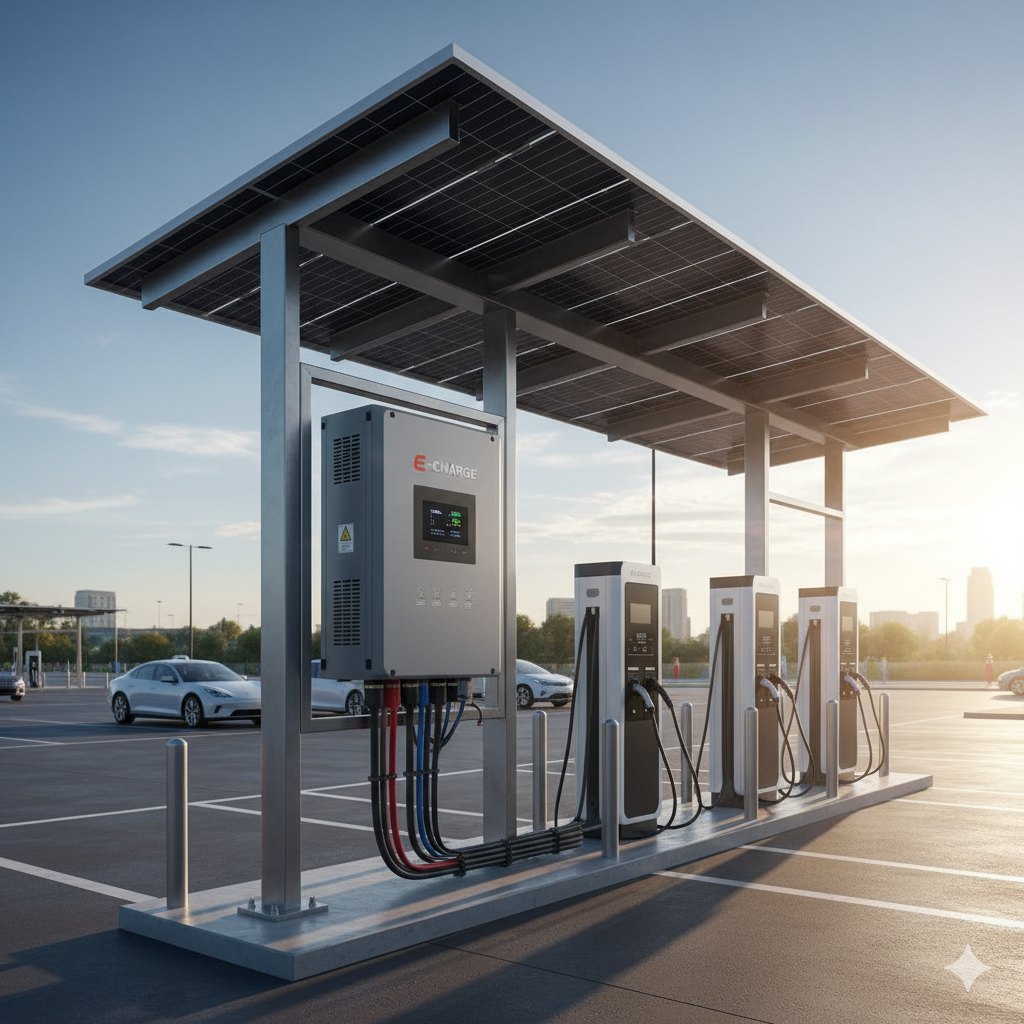
Driving Energy Transformation in E-Mobility
Electric vehicles are no longer niche; they’re the cornerstone of future transportation. However, rapid EV adoption presents a major challenge: how to deliver clean, stable power for charging stations that often operate at high load and varying demand levels.
This is where the inverter for EV charging stations comes in. It bridges renewable generation, grid supply, and high-power charging units, converting DC solar energy or grid power into the precise voltage and frequency required for fast, reliable charging.
Why the Inverter is Central to EV Charging Infrastructure
Charging stations must manage fluctuating loads, power surges, and renewable inputs — all without compromising charging time or safety. The inverter ensures this balance through intelligent conversion and grid synchronization.
| Function | Description | Impact |
|---|---|---|
| Power Conversion | Converts DC solar or storage energy to AC/DC for charging units | Enables high-speed charging |
| Load Balancing | Regulates multi-vehicle charging sessions | Prevents power dips |
| Grid Interaction | Supports bidirectional energy flow (V2G) | Stabilizes local grid |
| Energy Storage Control | Manages battery backup during off-peak or outage periods | Reduces grid stress |
| Smart Monitoring | Tracks efficiency, temperature, and fault conditions | Enhances reliability |
Modern systems often combine solar + storage + grid through a hybrid inverter, creating an intelligent charging network that can operate both on-grid and off-grid.
Technical Edge of Modern EV Charging Inverters
To keep up with rising EV power demands, inverter technology has evolved toward higher efficiency, modularity, and intelligent communication.
-
High Conversion Efficiency (≥98%) — Reduces energy loss during fast charging cycles.
-
High Voltage Range (up to 1500 V DC) — Supports multiple charging points simultaneously.
-
Real-Time Communication Protocols — Integrates with OCPP and smart metering systems.
-
Active Cooling Design — Ensures stable operation in outdoor or high-temperature environments.
-
Bidirectional Power Flow — Enables Vehicle-to-Grid (V2G) or Vehicle-to-Building (V2B) functions.
These features make inverters the backbone of sustainable EV infrastructure — where uptime and power quality are non-negotiable.
Integrating Solar Power with EV Charging Stations
Pairing solar systems with inverters for EV charging stations brings new value to operators and municipalities.
It reduces grid dependency, utilizes daytime solar peaks, and enhances energy economics.
| Setup Type | Key Components | Benefits |
|---|---|---|
| On-Grid Solar EV Station | Solar panels + inverter + grid | Lowers electricity bills |
| Hybrid Station | Solar + inverter + battery + grid | Ensures operation during outages |
| Off-Grid Station | Solar + inverter + storage | Suitable for remote highways or rural zones |
A hybrid inverter automatically switches between solar, grid, and battery sources — maintaining charging continuity even under unstable grid conditions.
Real-World Use Case: Commercial Fleet Charging
A logistics company in Southeast Asia installed a 200 kW solar-hybrid inverter system to power its EV delivery fleet. The system now:
-
Cuts grid energy costs by 35%
-
Provides full charging backup for up to 6 hours
-
Offsets 180 tons of CO₂ annually
This demonstrates how inverter-based infrastructure can make large-scale EV operations both sustainable and cost-efficient.
Key Considerations for Selecting an EV Charging Inverter
| Selection Criteria | Technical Recommendation | Why It Matters |
|---|---|---|
| Power Rating | 50 kW–250 kW (per station) | Matches multi-port fast chargers |
| Inverter Type | Hybrid / Bidirectional | Supports solar + grid + storage |
| Protection Level | IP65 or above | Outdoor weather resistance |
| Communication | OCPP, RS485, CAN | Enables centralized control |
| Efficiency | ≥98% | Reduces heat and loss during conversion |
Tip: For urban charging hubs, choose inverters with dynamic load management and predictive maintenance capabilities — this ensures system uptime and energy optimization.
Frequently Asked Questions
Q1: Can inverters support DC fast charging?
Yes. Specialized DC inverters regulate current flow directly to fast-charging units, improving charging speed and efficiency.
Q2: Are EV inverters compatible with renewable energy?
Absolutely. Hybrid inverters allow seamless integration of solar panels and battery storage, maximizing sustainability.
Q3: What is the lifespan of an EV charging inverter?
Most units last 10–15 years, depending on environmental conditions and usage intensity.
Q4: Can EV charging stations operate during grid failure?
With hybrid inverters and battery backup, they can continue operating in islanded mode to maintain basic charging functions.
Powering the EV Revolution with Reliable Energy Systems
The transition to electric mobility depends on infrastructure that is both efficient and adaptable. Inverters serve as the technological bridge that connects clean energy generation with high-demand charging applications.
ThlinkSolar develops inverter solutions engineered for EV charging networks — ensuring consistent performance, intelligent control, and compliance with global safety standards. Whether for fleet depots, public stations, or highway service areas, our hybrid inverter systems provide the reliability that future mobility depends on.
To learn more about customized inverter solutions for EV charging stations, visit our homepage or reach our technical team via the contact page.